
Home EV Charger in California (2026): Solar-Powered Setup, Panel Upgrade, Costs & Installation Guide
- Mar 21
- 13 min read
Updated: Apr 29
It was 9:00 PM on a Tuesday.
I'd just finished a long shift and all I wanted was to collapse on the couch. Instead, I was sitting in a dark parking lot at a Tesla Supercharger because my battery had hit 5%. I spent an hour there, scrolling my phone while the charge slowly trickled in. That month's public charging bill hit $180.
I'd switched from gas to electric — and it felt like I'd just swapped one bill for another.
After that, I installed a Level 2 charger at home. But the installation process raised more questions than I expected: "Can my electrical panel actually handle this?" "If I have solar, how much will I actually save?" "What happens if I skip the panel upgrade?"
After eight years supplying equipment to solar and electrical installers across Los Angeles, I'd seen the realistic answers to all of these play out in real homes. That's what this guide is based on.
In California in 2026, there are three typical situations for homeowners adding an EV charger: homes that already have solar, homes starting from scratch with both solar and a charger, and homes that want a charger without solar. The costs, electrical requirements, and economics look different in each case — so this guide covers them separately.
If you're still weighing the broader solar investment before thinking about a charger, Is Solar Still Worth It in California 2026 Without the Federal Tax Credit? covers the current numbers.
Quick Answer:

A home Level 2 EV charger in California costs anywhere from $1,250 to over $20,000 depending on whether your electrical panel needs upgrading and whether solar is part of the project.

Panel capacity check comes first. Charger selection comes second.
Table of Contents
How a Home EV Charger Actually Works
What to Check Before Installing: Electrical Panel Capacity
What Happens If You Install an EV Charger Without a Panel Upgrade?
Electrical Panel Upgrade: Costs, Timing, and Whether You Actually Need One
Solar-Powered EV Charging: How Much Does It Actually Save?
Home EV Charger Costs in California 2026: Three Scenarios
Solar-Integrated vs. Grid-Only: Which Makes More Sense?
Step-by-Step Installation Guide
FAQ
Conclusion
Related Posts
How a Home EV Charger Actually Works
Before getting into costs, it helps to clarify the terminology. A lot of homeowners come in confused about Level 1 versus Level 2, and that confusion often leads to the wrong setup.
Level 1 charging (120V):
You plug directly into a standard household outlet — no installation required. The downside is speed. Most EVs gain only 40–50 miles of range overnight on Level 1. If you drive short distances and charge on weekends, this can be enough. For daily commuters, it usually isn't.
Level 2 charging (240V):
Requires a dedicated circuit and professional installation, but charges 5–8 times faster than Level 1. At 40–48 amps, a Level 2 charger delivers roughly 9–11.5 kW of charging power. Most EVs reach full charge in 4–8 hours. For anyone driving daily, Level 2 is effectively the standard.
One thing worth clarifying: the charger itself doesn't generate electricity. It draws from whatever power source the home has — the grid, rooftop solar, or a battery — and transfers that power to the vehicle. That's why the condition of your home's electrical infrastructure matters more than which charger you pick.
What to Check Before Installing: Electrical Panel Capacity
More homeowners get stuck at this step than any other. The right question to ask before choosing a charger is:
"What's my electrical panel's amperage rating?"
California homes typically fall into one of three categories:
100A panel:
Common in homes built before the 1980s. Handles standard household loads — refrigerator, air conditioning, lighting, washer/dryer — without issue. But adding a 40–48A Level 2 charger means a single device is claiming close to half the panel's total capacity. If the AC and the charger run simultaneously at full load, the main breaker can trip. In older wiring configurations, sustained high load can also create heat buildup in ways that aren't immediately obvious.
150A panel:
Found in some mid-era homes. There's more headroom than a 100A panel, but depending on existing load patterns, a subpanel or load management device may still be necessary before adding a Level 2 charger.
200A panel:
The current new-construction standard and the most practical starting point for Level 2 charger installation. In most cases, a 200A panel with available breaker slots can accommodate a charger dedicated circuit without a full panel upgrade.
Checking your panel is straightforward: open the electrical panel box in your garage or utility room and look at the main breaker. The amperage rating — 100, 150, or 200 — is printed on it.

What Happens If You Install an EV Charger Without a Panel Upgrade?
This is the section most EV charger guides skip. There's plenty of information online about charger costs and models, but the question of what actually happens when panel capacity doesn't match charger demand rarely gets a direct answer.
The short version: installing a Level 2 charger on an underpowered panel leads to one of three outcomes.
Outcome 1: The breaker keeps tripping.
This is the most common result. When the charger runs alongside the air conditioner, dryer, or other high-draw appliances, the main breaker trips. Charging stops, part of the home loses power, and the homeowner has to manually reset the breaker. It's frustrating and repetitive — but at least it's visible.
Outcome 2: The wiring overheats.
This is the less visible and more dangerous outcome. Older 100A panels sometimes have wiring that wasn't designed to sustain high continuous loads. When a charger and air conditioner run together for extended periods during a California summer, that wiring can overheat. The breaker may not trip fast enough to prevent heat buildup. In California — where electrical fires in wildfire risk zones carry serious consequences — this is not a theoretical concern. Insurance claims stemming from unpermitted electrical work are routinely denied. An unpermitted charger installation that contributes to a fire can leave the homeowner fully exposed.
Outcome 3: The permit gets rejected.
A licensed C-10 electrician is required to perform a load calculation before installation. Under NEC guidelines, adding a 40A dedicated circuit to a 100A panel with existing loads often fails the load calculation. The permit doesn't get issued. Installing without a permit creates problems at resale — title companies and buyers' inspectors find unpermitted electrical work, and it has to be disclosed or corrected.
"Can I just use a smaller 30A charger instead?"
This comes up regularly. A 30A Level 2 charger delivers roughly 7.2 kWh per hour — slower than a 40–48A unit (9–11.5 kWh/hour) but still substantially faster than Level 1. On a 100A panel where no upgrade is feasible, a 30A circuit may be the realistic option. However, even this depends on the load calculation result — existing loads on some 100A panels leave little room even for a 30A addition.
Smart load management devices are a middle-ground option.
Products like Emporia, Span, and Leviton smart panels monitor total home load in real time and only allocate power to the charger when capacity is available. This prevents overload without requiring a full panel upgrade. The cost is typically $500–$1,500 for the device plus installation, and a licensed electrician still needs to perform the load calculation to confirm it's appropriate for the specific home.
The core takeaway:
Get a licensed electrician's load calculation before buying a charger. Skipping this step is the single most common reason homeowners end up paying more than they planned.
Electrical Panel Upgrade: Costs, Timing, and Whether You Actually Need One
Once a load calculation comes back requiring an upgrade, the next question is always cost.
2026 Electrical Panel Upgrade Costs in California:
Upgrade Type | Estimated Cost Range |
100A → 200A upgrade | $2,000–$4,500 |
Subpanel addition (keeping 200A main, adding garage circuit) | $1,000–$2,500 |
Smart load management device installation | $500–$1,500 |
200A → 400A upgrade (solar + battery + EV full integration) | $4,000–$8,000 |
The wide ranges reflect real variables: the utility company's service upgrade fee (PG&E, SCE, and SDG&E each handle this differently), permit and inspection costs, whether exterior wall penetration is needed, distance from panel to charger location, and whether any older wiring needs to be brought up to current code.
When a panel upgrade is clearly necessary:
100A panel with a 40A+ charger circuit being added
Solar + battery + EV charger being integrated into the same home
Existing panel already running at 80%+ of rated capacity
When a panel upgrade can potentially be avoided:
Existing 200A panel with available breaker slots
30A or smaller charger circuit being added with favorable load calculation
Smart load management device confirmed appropriate by a licensed electrician
Federal tax credit consideration:
The federal EV charger tax credit (30%, up to $1,000) applies to charger hardware and installation costs for eligible installations through June 30, 2026. Whether panel upgrade costs qualify depends on how directly they're tied to the charger installation — a tax professional should confirm this for your specific situation.
For a full breakdown of available rebates and incentives for Level 2 chargers in California, Level 2 EV Charger Rebates in California 2026: How to Apply covers the current programs.
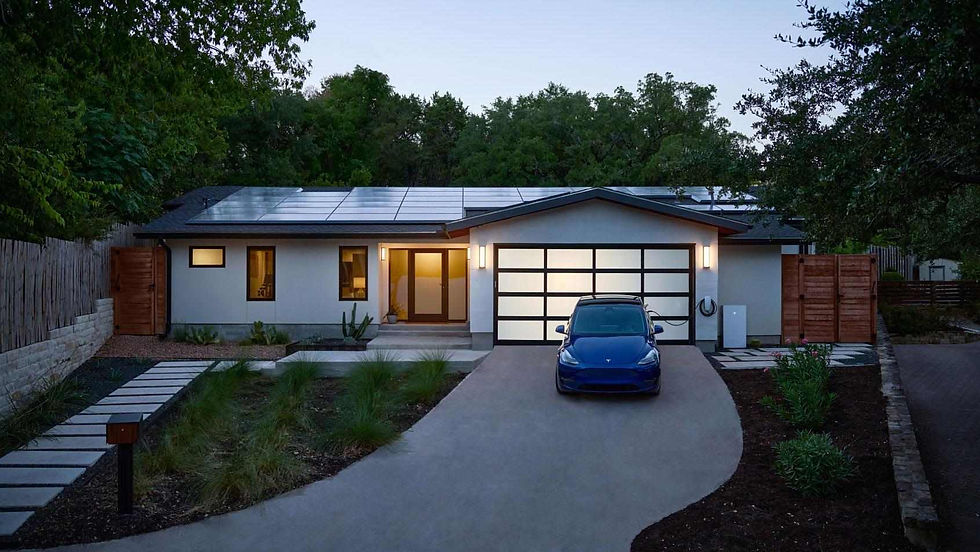
Solar-Powered EV Charging: How Much Does It Actually Save?
For homes with existing solar, adding an EV charger isn't just a convenience upgrade. Under NEM 3.0, it becomes one of the most practical ways to improve the financial performance of the whole solar system.
Why charging timing matters under NEM 3.0:
Under NEM 3.0, excess solar electricity exported to the grid earns only about 2–8¢/kWh depending on utility territory (CPUC NEM 3.0 decision, December 2022). But buying electricity back from the grid during evening peak hours (4–9 PM) costs 30–40¢/kWh or more. That's a gap of up to 20x.
Charging your EV directly from solar production during the day means using energy that would otherwise be exported at low value — and avoiding the expensive grid electricity you'd otherwise buy in the evening. That's the core of the economics.
Estimated annual savings — California example:
Assumptions: 15,000 annual miles, 3.5 miles/kWh efficiency, SCE territory.
Annual charging demand: approximately 4,286 kWh
Grid-only charging at average 35¢/kWh: approximately $1,500/year
70% solar self-consumption during daytime charging: approximately $450–$650/year
Estimated annual savings: $850–$1,050
These numbers require daytime charging — roughly 10 AM to 4 PM. This works well for homeowners who work from home or leave the car parked during the day. For daily commuters, the practical alternative is setting a smart charger timer to charge during off-peak late-night hours (midnight to 6 AM at 15–22¢/kWh) rather than plugging in immediately after returning home during the 4–9 PM peak window.
With battery storage:
A home battery allows daytime solar production to be stored and used for EV charging at night — capturing the self-consumption benefit even for drivers who aren't home during peak solar hours. Battery storage adds $13,000–$16,500 to installed system cost.
For a full breakdown of whether that investment makes sense under NEM 3.0, Solar Battery Costs in California 2026: Price Breakdown covers the numbers in detail.
For the full picture of how NEM 3.0 reshapes solar self-consumption strategy, NEM 3.0 California Explained (2026): Solar Costs, Battery Savings & Is It Still Worth It? is a useful reference.
Home EV Charger Costs in California 2026: Three Scenarios
Because the cost picture looks very different depending on starting conditions, here are three realistic scenarios.
Scenario A: Solar Already Installed — Charger Addition Only
The most cost-effective situation.
Item | Estimated Cost |
Level 2 charger (40–48A) | $450–$900 |
Installation labor + permit | $800–$2,500 |
Gross total (before incentives) | $1,250–$3,400 |
Federal EV charger tax credit (30%, up to $1,000 for eligible installations through June 30, 2026, subject to census tract and primary residence conditions):
Estimated net cost if eligible: $875–$2,400
If the home already has a 200A panel with available slots, no additional upgrade is typically needed and the project stays within this range.
Scenario B: No Solar — New Solar + EV Charger Installation
A long-term energy investment rather than a simple charger upgrade.
Item | Estimated Cost |
5–6 kW solar system | $12,500–$15,000 |
Level 2 charger + installation | $1,250–$3,400 |
Full project total | $14,000–$20,000 |
Critical 2026 update:
The Residential Clean Energy Credit (30%) does not apply to solar systems placed in service after December 31, 2025
The EV charger credit may still apply separately (up to $1,000 for eligible installations)
Net project cost in 2026 is therefore higher than estimates based on pre-2026 incentive assumptions
This scenario should be evaluated as a 25-year energy cost investment, not a short-term payback calculation. For a realistic payback timeline under current California conditions, Solar Payback Period California 2026: Step-by-Step Guide walks through the math.
Scenario C: No Solar — Grid-Only Charger Installation
The fastest and simplest option.
Item | Estimated Cost |
Level 2 charger | $450–$900 |
Installation labor + permit | $800–$2,500 |
Panel upgrade (if required) | $2,000–$4,500 |
Total with panel upgrade | $3,250–$7,900 |
Grid-only charging cost per mile depends heavily on when you charge. In SCE territory in 2026, peak hours (4–9 PM) run approximately 38–45¢/kWh, while off-peak late-night hours (midnight to 6 AM) run approximately 15–22¢/kWh. Setting a smart charger to charge overnight rather than immediately after returning home can reduce monthly charging costs by 40–50% with no additional hardware investment.
For a detailed breakdown of why California EV charging costs are high and how to reduce them, Why Your EV Charging Cost Is So High in California 2026 (And 5 Ways to Fix It) covers the specifics.
Solar-Integrated vs. Grid-Only: Which Makes More Sense?
Feature | Solar-Integrated EV Charger | Grid-Only Charger |
Upfront cost | $8,000–$20,000 (solar included) | $1,250–$7,900 |
Cost per mile | Significantly lower when aligned with solar production | ~$0.04–$0.06 (off-peak) |
Investment framing | Long-term energy cost reduction | Convenience upgrade |
Outage charging | Possible with battery storage | Not possible |
NEM 3.0 fit | Maximizes self-consumption value | Requires smart charging schedule |
Best for | Homes with existing solar or long-term investment goal | Fastest setup, immediate daily convenience |
Step-by-Step Installation Guide
Here's how a legal, properly permitted Level 2 charger installation works in California in 2026.
Step 1: Load calculation (1 day)
Contact a licensed C-10 electrician for a load calculation before purchasing a charger. The electrician evaluates current panel capacity, existing loads, and available headroom. This step is what most homeowners skip — and skipping it is the most common cause of unexpected additional costs later.
Step 2: Permit application (1–2 weeks)
The electrician pulls the electrical permit. Most California cities have streamlined EV charger permitting, but projects involving solar integration or panel upgrades take longer. Do not begin installation before the permit is issued.
Step 3: Panel upgrade (if required)
Based on the load calculation, a panel upgrade or subpanel addition may be needed. This is typically the most time-consuming and expensive part of the project.
Step 4: Charger mounting and wiring (4–8 hours)
A 40–48A Level 2 charger is hardwired using #6 AWG copper wire in conduit, run from the dedicated breaker to the charger location on the garage wall or exterior.
Step 5: Smart integration (optional)
For homes with solar, the charger is connected to an energy monitoring system that automatically prioritizes charging during peak solar production hours. Enphase, SolarEdge, and several smart charger brands support this natively.
Step 6: Inspection and activation
A city inspector signs off on the installation. Smart charger scheduling and solar-priority mode are configured in the app.
Safety note:
240V electrical work must be performed by a licensed C-10 electrician. In California wildfire risk zones, unpermitted electrical installations that contribute to fires can result in denied insurance claims. DIY is not appropriate for this work.
FAQ
Q: Can I connect a new EV charger to an existing solar system?
A: In most cases, yes. The answer depends on system size, daytime production, panel capacity, and the vehicle's daily charging demand. A licensed electrician's load calculation is required before proceeding.
Q: Can I install a Level 2 charger on a 100A panel?
A: Technically possible in some cases, but a load calculation is mandatory. If existing loads are already high, a panel upgrade or smart load management device is likely required. Installing without a permit on an undersized panel creates both safety and insurance risk.
Q: Is the federal EV charger tax credit still available in 2026?
A: It may be — 30% up to $1,000 for eligible installations through June 30, 2026. Conditions include primary residence requirement, eligible census tract, and service date. Confirm with a tax professional for your specific situation.
Q: Is installing a charger without solar still worth it?
A: Yes. Scheduling overnight charging during off-peak hours (15–22¢/kWh in SCE territory) versus peak evening rates (38–45¢/kWh) can reduce monthly charging costs by 40–50%. The convenience of daily home charging also eliminates most public charging dependency.
Q: Can I charge my EV during a power outage using rooftop solar?
A: Not in most configurations. Rooftop solar alone doesn't provide power during a grid outage — the system shuts down as a safety measure. EV charging during an outage requires battery storage and a properly designed backup system.
Q: I mostly charge at night. Does solar integration still make sense?
A: With a battery, yes — daytime solar is stored and available for nighttime EV charging. Without a battery, the most practical approach is scheduling charging during off-peak late-night hours using your utility's time-of-use rate plan.
Q: What's the practical difference between a standard Level 2 charger and a solar-aware smart charger?
A: A standard Level 2 charger charges at a fixed rate based on schedule. A solar-aware smart charger monitors real-time solar production and adjusts charging speed or start time to maximize the use of available solar output. For homes with solar, the difference in self-consumption efficiency is meaningful.
Q: What should I verify before signing an installation contract?
A: Panel amperage, contractor C-10 license, permit inclusion, UL-listed equipment, current rebate and tax credit eligibility, and whether the proposed charger is sized appropriately for both current and future vehicles.
Q: What's the best time of day to charge an EV using solar power in California?
A: For most California homes, 10 AM to 4 PM aligns with peak solar production and allows the highest proportion of solar-supplied charging. For grid-only setups, midnight to 6 AM captures the lowest off-peak rates.
Conclusion
A home EV charger is one of the more straightforward home energy upgrades — until you get into the details of panel capacity, solar timing, and permit requirements.
The most common mistake I saw over the years was homeowners buying a charger before getting a load calculation. The second most common was homeowners with solar who plugged in every evening at 6 PM and couldn't figure out why their electricity bill wasn't dropping.
The sequence matters: check panel capacity first, get a load calculation, decide on your charging scenario, then choose the charger. That order prevents the unexpected add-on costs that catch most people off guard.
For the full picture of how gas savings, solar, battery storage, and EV charging all fit together financially, Can Gas Savings Pay for Solar, Battery, and EV Charging in California? walks through the combined math.
Related Posts
About the Author
James Ree has eight years of experience in electrical, HVAC, and solar wholesale in Los Angeles, supplying equipment to residential and commercial installers. He now writes practical guides on solar, EV charging, battery storage, and home electrical systems for U.S. homeowners.
Disclaimer
Costs and regulations can change over time and vary by location. Confirm details with your local utility and a licensed installer before making decisions.
Safety Note
240V electrical work must be performed by a licensed C-10 electrician. Unpermitted DIY installations can create safety hazards and may void homeowner's insurance coverage.


