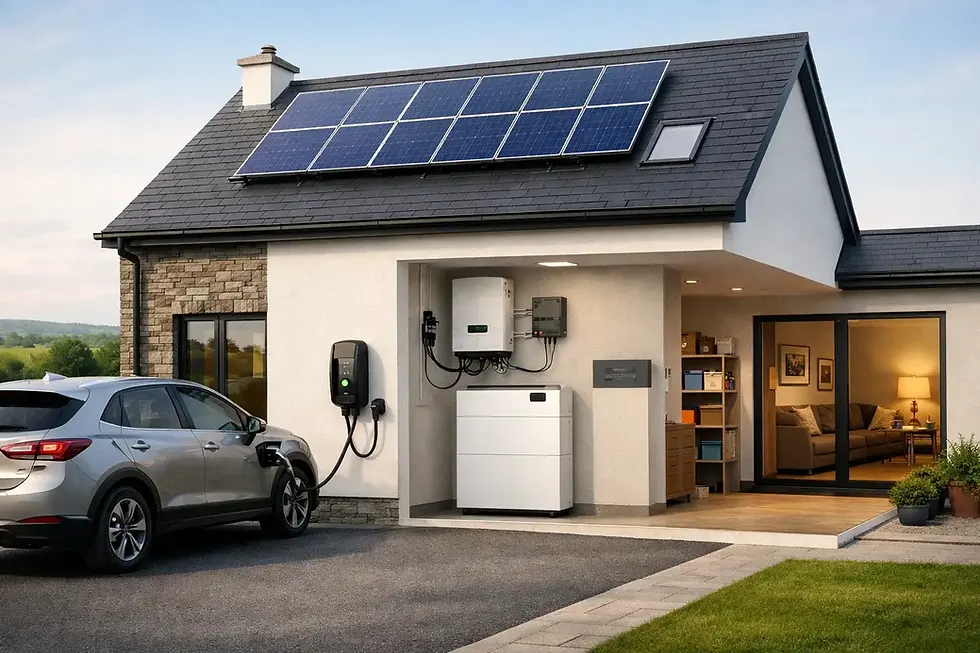
Solar Installation Guide in California (2026): Costs, Timeline, Battery, Panel Upgrade & EV Charger
Updated: May 16
When homeowners start looking into solar, it usually seems straightforward at first. Put some panels on the roof, connect an inverter, reduce the electricity bill. The reality of a California solar installation in 2026 is more involved than that.
A complete California solar installation today means permits, utility interconnection, electrical panel evaluation, battery storage design, and EV charger integration — not just hardware on a roof. The hands-on installation work takes a few days. Getting from a signed contract to Permission to Operate (PTO) typically takes two to four months. With a panel upgrade, battery, and EV charger included, some projects run five to six months.
I spent 8 years supplying solar, electrical, and HVAC equipment to contractors across Los Angeles. The projects that went smoothly and the ones that got stuck mid-process almost always diverged in the preparation phase — what was confirmed before contracts were signed, which questions were asked of installers, and what was included in the scope from the beginning.
This guide covers what a California solar installation actually looks like in 2026: costs broken down by component, a realistic step-by-step timeline, what changes when battery storage and an EV charger are included from the start, and what to verify before signing anything.
Table of Contents
What to Do Before Your California Solar Installation Starts
How a California Solar Installation Actually Works: Step by Step
What Does a California Solar Installation Cost in 2026?
Permits and Utility Approval: The Real Timeline for California Solar Installation
Why Battery and EV Charger Should Be Part of the Initial California Solar Installation
What to Confirm Before Signing a California Solar Installation Contract
FAQ
Related Posts

What to Do Before Your California Solar Installation Starts
There's a set of things homeowners can confirm before the first installer conversation. Doing this preparation early makes every subsequent step more productive — and helps you evaluate whether what an installer proposes actually fits your home and usage.
1. Check Your Roof Condition
Solar panels are designed to last 25–30 years. The roof underneath needs to carry that weight for the same period. Re-roofing after panels are installed means taking the entire system down and putting it back up — a process that typically adds $3,000–$8,000 to the project cost.
If your roof has less than 10 years of remaining life, replacing it before the California solar installation is the right sequence. Most licensed California installers won't proceed on a roof with less than a decade left, or they'll require separate roofing work as a condition of the contract.
What to check yourself: cracked or missing shingles, sagging sections, moss or water staining, and the condition of flashing around chimneys and vents. If you're unsure, a roofer's inspection typically runs $150–$300 and takes about an hour.
2. Pull 12–24 Months of Utility Bills
Solar system sizing is based on actual electricity consumption. A single recent month misses seasonal variation — summer AC loads, winter heating, months with higher EV charging. Twelve to twenty-four months of data gives an installer what they need to size the system accurately.
SCE, PG&E, and SDG&E all allow monthly kWh data to be downloaded from their online portals. Bring this to the first installer meeting. It lets you verify that the proposed system size actually matches your usage pattern — not a generic estimate.
Key things to note: total monthly kWh by month, peak usage time windows (4–9 PM is most expensive under NEM 3.0), and any usage spikes tied to EV charging or appliance additions.
3. Check Your Electrical Panel Capacity
Open the panel door and read the number off the main breaker. If it reads 100 or 125, a panel upgrade is likely required before a full solar-plus-battery-plus-EV system can be installed. If it reads 200, the answer depends on system size and existing loads — not a guaranteed pass.
The age of the home is a useful indicator. Most California homes built before the mid-1990s still have 100A or 125A service. Knowing this number before the first installer conversation lets you immediately confirm whether a panel upgrade is being included in their scope — or being left out for a change order later.
For a full breakdown of when an upgrade is needed, what it costs, and what to watch out for, this guide covers electrical panel upgrades for solar and EV in California in detail.
4. Check HOA Rules
California's Solar Rights Act prevents HOAs from unreasonably blocking solar installations, but some still require architectural approval forms before work begins. That approval process can take two to four weeks and runs on the HOA's timeline, not the installer's.
If you have an HOA: review the CC&Rs for solar-related provisions and find out what documentation is required. Starting this process early — in parallel with permitting — prevents it from becoming a bottleneck.
5. Assess Shading
Which parts of your roof receive unobstructed sun, and which are shaded by trees, chimneys, or neighboring structures, directly affects panel placement and inverter selection. Shading of 10–15% or more makes microinverters the better choice over string inverters — and that affects system cost and design.
Two free tools for a preliminary shading assessment: Google Earth Pro's solar analysis feature and NREL's PVWatts calculator. Enter your address and get a rough picture of annual sun exposure by roof section.
How a California Solar Installation Actually Works: Step by Step
The full timeline for a California solar installation looks long on paper. Understanding what happens at each stage — and where delays come from — makes it manageable.
Step 1: Site Assessment and Energy Audit (1–2 weeks)
A licensed installer (NABCEP-certified preferred) visits the property for a 2–4 hour assessment. They inspect the roof's age, pitch, orientation, shading patterns, and structural condition — often using a drone or Solmetric shade tool for precise measurements. They review the electrical panel and meter, and go through 12–24 months of utility bills to establish actual kWh usage, peak-hour patterns, and EV charging load.
The output is a system size recommendation — typically 8–12 kW solar plus 10–13 kWh battery for an average California home — along with a load calculation that determines whether a panel upgrade is required.
Your role: have utility bills ready, provide clear access to the roof and garage, and be prepared to discuss outage history and daily driving miles.
Cost: usually free. Some installers charge $99–$199 if you don't sign.
One important point: any installer who provides a quote without a site visit is giving you an estimate with unknowns built in. Require a site visit before any quote is finalized.
Step 2: System Design and Proposal (1–3 days after assessment)
The site data gets turned into CAD drawings showing exact panel layout, inverter placement, battery location, conduit runs, and EV charger circuit. Production is modeled using PVWatts or Aurora software, with NEM 3.0 export rates (typically $0.05–$0.08/kWh) factored into the savings calculation.
What to review carefully in the proposal:
How shading is handled (microinverters vs. optimizers)
Which circuits are covered by battery backup
Smart monitoring app integration
Whether panel upgrade is included and at what cost
Everything in the proposal needs to be reflected in the contract. Review both documents side by side before signing.
Step 3: Permitting (1–4 weeks, same day with SolarAPP+)
The installer submits electrical diagrams, structural calculations, Title 24 energy forms, and equipment spec sheets to the city or county building department.
In 2026, most California jurisdictions use SolarAPP+ for automated approval of standard residential systems under 10–15 kW. If the project qualifies, permits can be issued the same day. Larger systems or older homes requiring manual review typically take one to four weeks. Permit fees are generally capped at $200–$450 base, plus $15 per kW over 15 kW.
Your role: sign the permit application; provide HOA approval documentation if required. The permit must be issued in the homeowner's name — not only in the installer's name.
Ask your installer upfront whether they use SolarAPP+. If they do, the permitting stage can be weeks shorter.
Step 4: Electrical Panel Upgrade (if needed, 1–2 days)
Approximately 65–70% of full California solar installation projects that include battery storage and a Level 2 EV charger require a panel upgrade. The existing 100A or 125A service can't handle the combined load of a solar inverter, battery system, and 48A EV charger running simultaneously.
Power is off for 4–8 hours on installation day. Homeowners who work remotely, use medical equipment, or have refrigeration-sensitive items should plan accordingly.
Doing the panel upgrade as part of the California solar installation — rather than as a separate project later — saves $1,500–$3,000 in duplicated labor and permitting costs.
Step 5: Physical Installation (1–3 days)
A crew of four to six arrives with equipment. Day 1: roof racking, flashing, and panel mounting. Day 2: inverter, battery, conduit, and wiring. Day 3: EV charger wiring and system programming. Every roof penetration is sealed. Grounding is tested.
Expect noise and foot traffic. Keep pets and children away from the work area. Having parking and bathroom access available makes the process smoother.
Step 6: Inspections (1–2 weeks after installation)
A city inspector verifies electrical wiring, grounding, rapid shutdown devices, and labeling. Battery systems may require a separate fire marshal or structural review. Pass means the installer can submit for PTO. Fail means corrections and re-inspection.
Common inspection failures in California: missing bonding connections, incorrect breaker sizing, and battery placement that doesn't meet fire code clearance requirements. An experienced installer anticipates these and catches them before the inspector arrives.
Step 7: Utility Interconnection and PTO (2–8 weeks)
The installer submits final as-built drawings, test results, and proof of insurance to PG&E, SCE, or SDG&E. The utility reviews for Rule 21 compliance, swaps the meter for a bidirectional unit if needed, and issues PTO.
Do not turn the system on before PTO is issued. Doing so voids equipment warranties and creates grid safety issues.
Realistic wait times:
Solar only: 10–15 business days
Solar + battery + EV charger: 4–8 weeks (additional engineering review required)
Your role: sign the net billing agreement promptly, submit any missing documents quickly, and follow up weekly. Polite follow-up with the utility actually moves things along.
Full project timeline summary:
Solar only: 2–3 months contract to PTO
Solar + battery + EV + panel upgrade: 3–5 months
Complex systems or high-volume utility areas: up to 6 months
What Does a California Solar Installation Cost in 2026?
When budgeting for a California solar installation, the total number matters less than understanding what's inside it. Two quotes for the same system size can differ by $8,000–$10,000 depending on what's included and what's been left out.
Component Cost Breakdown
Component | Basic | Typical | Premium |
Solar panels + racking (8–10 kW) | $11,500 | $14,000–$16,500 | $18,000+ |
Inverter (string or Enphase IQ8) | $1,800 | $2,800–$4,200 | $5,000+ |
Electrical panel upgrade | $2,800 | $3,500–$5,000 | $6,000+ |
Battery storage (10–13 kWh LFP) | $9,500 | $13,000–$15,600 | $17,000+ |
Level 2 EV charger + wiring | $850 | $1,200–$2,000 | $2,500+ |
Labor, permits, conduit, interconnection | $3,500 | $4,500–$6,000 | $7,500+ |
Total turnkey cost | $29,950 | $39,000–$49,300 | $56,000+ |
April 2026 California estimates. Includes labor, permits, and interconnection. Actual quotes vary by location, roof complexity, and equipment brand.
Cost Comparison by System Configuration
System Configuration | Installed Cost | Est. Monthly Savings | Payback Period |
Solar only (8–10 kW) | $18,000–$28,000 | $150–$250 | 8–12 years |
Solar + battery | $32,000–$43,500 | $300–$450 | 7–10 years |
Solar + battery + EV charger | $33,500–$45,500 | $400–$550 | 6–9 years |
Based on NEM 3.0 and SCE TOU rates. Actual results vary by usage pattern, rate schedule, and incentive eligibility.
Costs Frequently Missing From Initial Quotes
These are the items that most commonly appear as change orders after the contract is signed.
Roof reinforcement or new flashing: $800–$2,000
Required when roof condition is marginal or flashing is deteriorated. Sometimes discovered during installation rather than the initial site visit.
Trenching for long conduit runs: $1,200–$3,000
Applies when the distance between the panel or battery and the meter requires underground wiring. Most common in homes with underground utility service.
Smart load controller: $1,500
An option for homes where a full 400A upgrade can be avoided through active load management. Worth asking about if the panel upgrade quote seems high.
Grounding upgrade: $200–$500
Older homes sometimes need the grounding system brought to current code as part of the panel replacement. Small cost, frequently omitted from initial quotes.
Battery storage is typically the largest single line item in a full California solar installation. For a detailed breakdown of battery costs by product and installation scope — and what most quotes leave out — this guide covers solar battery costs in California in 2026.
Practical tip: Ask every installer for a turnkey, all-in price — permits, panel upgrade, trenching if applicable, grounding, and final inspection included. The difference between a base hardware quote and the actual all-in cost is often $5,000–$8,000. That's the only number that matters for your payback calculation.
SGIP Battery Incentives: Current Status (April 2026)
The Standard Residential SGIP budget was largely exhausted by late 2025. However, the RSSE (Equity Resiliency) tier remains active in limited categories:
Low-income households in High Fire Threat Districts may still qualify for $850–$1,100/kWh incentives
A qualifying single battery system could see $8,000–$13,000 in incentives
Ask each installer to confirm current eligibility in writing before factoring any SGIP amount into your budget. Don't treat it as guaranteed.
Permits and Utility Approval: The Real Timeline for California Solar Installation
California's permitting process has improved significantly in 2026, but there are still stages where time accumulates. Knowing where that time goes makes it easier to set realistic expectations.
SolarAPP+: What It Is and How It Affects Your Timeline
SolarAPP+ is NREL's automated permit platform, now adopted by most California cities and counties for standard residential systems under 10–15 kW. When the installer uploads electrical diagrams, structural calculations, and equipment specs, the system automatically checks for code compliance and issues a permit — sometimes the same day.
Systems outside the standard parameters, or homes with more complex conditions, go to manual review: one to four weeks. Ask your installer upfront whether your project qualifies for SolarAPP+. If it does, you'll save weeks on the permitting stage.
Full Permit and Approval Timeline
Stage | Time Required | Who Handles It | Homeowner Role |
SolarAPP+ permit | Same day to 3 days | Installer | Provide signature |
Manual permit review | 1–4 weeks | City/county | HOA documentation |
Construction inspection | 1–2 weeks post-install | City inspector | Provide access |
Utility interconnection | 2–8 weeks | Utility | Sign net billing agreement |
PTO issuance | After above complete | Utility | Submit missing docs |
Where Most California Solar Installation Delays Come From
Utility interconnection is the most consistent source of timeline extension — and it can't be accelerated by the homeowner or installer. SCE and PG&E are processing a high volume of solar and electrification interconnection requests in 2026. Two to six weeks is realistic.
The second most common source of delay: items found during inspection that weren't caught earlier — missing bonding, incorrect breaker sizing, battery placement that doesn't meet fire code clearance. Working with an experienced installer who anticipates these issues reduces re-inspection risk significantly.
The utility interconnection process runs parallel to the NEM 3.0 enrollment timeline — and understanding how net billing actually credits your exported solar energy matters for how the system gets designed. This full NEM 3.0 breakdown explains how the policy works and what it means for your monthly bill.
Why Battery and EV Charger Should Be Part of the Initial California Solar Installation
Before NEM 3.0, a solar-only installation made strong financial sense on its own. Excess daytime solar exported to the grid earned a meaningful credit. Since NEM 3.0 took effect in April 2023, that export credit dropped by roughly 75%.
What NEM 3.0 Changed
Under the current structure, excess solar exported to the grid earns $0.02–$0.08 per kWh. Buying that electricity back in the evening costs $0.35–$0.45 per kWh under SCE TOU peak rates. A battery changes this equation by storing the daytime excess and using it during the expensive evening window instead of exporting it.
For a California solar installation in 2026, battery storage isn't an optional upgrade — it's what makes the financial case work under NEM 3.0.
Why Doing It Together Costs Less
Adding a battery to an existing solar installation after the fact often requires AC coupling — and if the existing inverter isn't compatible, it needs to be replaced. Additional wiring work and a separate permit add to the cost. Total incremental cost of retrofitting a battery onto a solar-only system: $2,000–$4,000 more than if it had been designed in from the start.
The same logic applies to the EV charger. Installing the charging circuit at the same time as the California solar installation means the work happens while the electrical panel is already open. A dedicated 50A circuit added separately later means a separate electrical job, separate permit, and separate labor cost.
Solar-First EV Charging
In 2026, smart chargers like the Enphase EV Charger and Wallbox communicate directly with the solar inverter to charge the vehicle only when excess solar production is available. This solar-first charging mode shifts EV charging from grid electricity to self-generated electricity — worth roughly $1,200–$1,500 in additional annual savings for a household driving 14,000–15,000 miles per year.
Getting the solar array sized correctly for a home that includes EV charging is one of the most common places where California solar installations underperform. This guide covers how to size a solar system specifically for EV owners in California in 2026.
What to Confirm Before Signing a California Solar Installation Contract
Based on what I saw across hundreds of California installations from the supply side, the projects that went as expected shared consistent characteristics in how the installer was selected and how the contract was structured.
Installer Qualifications to Verify
C-10 or C-46 license
Electrical panel work and solar installation in California require a C-10 (electrical) or C-46 (solar) contractor license. Verify the license number directly at cslb.ca.gov before signing. Takes two minutes.
NABCEP certification
North American Board of Certified Energy Practitioners certification indicates verified competency in solar system design and installation. Not every installer has it, but it's a meaningful signal of technical credibility when present.
Recent references from your area
Ask for references from installations completed in 2025 or 2026, in your city or nearby. References from one to two years ago are less relevant — installer quality can change. Actually call them.
Direct installation vs. sales-only crews
Door-to-door sales crews typically hand projects to subcontractors for installation. When problems arise, accountability becomes unclear. Working directly with the company that installs the system is the cleaner arrangement.
What to Review in the Contract
All-in price confirmation
A contract showing only hardware costs is not a complete contract. The final number should include permits, utility coordination, panel upgrade if required, trenching, grounding work, and final inspection. If it doesn't, ask for a revised version.
Warranty terms
Panels: 25-year product warranty
Inverter and battery: 10–12 years
Workmanship warranty: minimum 2 years
A California solar installation contract without a workmanship warranty means no one is accountable for installation defects after the crew leaves.
Permit issued in homeowner's name
The permit must be issued in the homeowner's name. A permit in only the installer's name creates complications at resale and during insurance claims.
Change order provisions
If additional costs arise after the site visit, how are they handled? The contract should specify which items could trigger additional charges and what the process looks like — not just a blanket clause saying "additional conditions may apply."
Comparing at least three quotes is the right approach — but many homeowners skip it because they don't want to deal with sales calls. This guide shows how to get California solar installation estimates without sharing your cont Trenching, grounding upgrades, and roof reinforcement are act information.
Trenching, grounding upgrades, and roof reinforcement are among the most common surprise costs in a California solar installation — but they're not the only ones. This guide covers 7 hidden costs that regularly add thousands to California solar projects, most of which don't appear in the initial quote.
Final Thoughts
A California solar installation in 2026 is a predictable, manageable project — when you go in prepared.
The projects that ran smoothly were the ones where roof condition was confirmed early, panel capacity was established before contracts were signed, battery and EV charger were included in the initial design, and all-in quotes were compared across at least three installers. The projects that hit unexpected costs and delays almost always traced back to one of those steps being skipped.
Under NEM 3.0, a solar-only system doesn't produce the same financial results it did a few years ago. Battery storage is what closes that gap. And an EV charger integrated from the beginning costs meaningfully less than one added later. Treating these three components as one project — rather than a solar installation with future add-ons — is the approach that makes the most financial sense in 2026.
FAQ
Q: Can I add a battery later if I start with solar only?
A: Yes, but it will cost more than if it had been included from the start. Adding a battery to an existing California solar installation typically requires AC coupling, which may mean replacing the existing inverter if it's not compatible. Additional wiring and a separate permit add $2,000–$4,000 to what the upgrade would have cost if designed in originally. Starting with a hybrid inverter eliminates this problem.
Q: Does SolarAPP+ really issue permits the same day?
A: For systems that fall within standard parameters and when the installer submits complete documentation, same-day or next-day automated approval is realistic. Systems outside those parameters go to manual review. Ask your installer whether your project qualifies before assuming the permitting stage will be fast.
Q: What happens if I turn the system on before PTO?
A: Equipment warranties are voided. Grid safety issues can arise. And the utility net billing agreement — which governs how your exported solar energy is credited — requires PTO before the system is energized. Wait for the official authorization.
Q: Is the cheapest quote usually a bad choice?
A: Often, yes. The lowest quote frequently reflects reduced scope on grounding, surge protection, or warranty coverage — or the use of subcontractors who aren't accountable to the company you signed with. Compare quotes item by item, not by total. What equipment is specified, what the warranty covers, and what's included in the all-in price matters more than the headline number.
Q: Is solar still worth it in California in 2026 without the federal tax credit?
A: For most California homeowners facing SCE, PG&E, or SDG&E rates, yes. The economics are driven by high electricity rates and the ability to avoid expensive peak-hour grid electricity through self-consumption and battery storage — not by the federal credit alone.
For a detailed look at how the numbers work in California without the federal credit, this guide breaks down whether solar is still worth it in California in 2026.
Q: Can I install solar myself to save money?
A: In California, a full residential solar installation involves electrical design, permitting, utility interconnection, rapid shutdown compliance, battery safety requirements, and inspection approval — all of which require licensed professionals. Unpermitted work fails inspection, voids insurance coverage, and creates issues at resale. The permit and licensing requirements exist for practical safety reasons.
** Costs, permit requirements, and incentive programs vary by location and change over time. Confirm current details with your utility provider and a licensed C-10 or C-46 contractor before making any final decisions.
Related Posts
About the author
Hi, I’m James Ree, founder of ElecGuys.
With 8 years of experience in electrical, HVAC, and solar wholesale in Los Angeles, I used to consult contractors and supply equipment for residential and commercial projects.
I now run this blog full-time to share clear, honest, and practical information with homeowners who are new to solar and home energy.
My goal is simple: to help you save money, avoid costly mistakes, and make smarter energy decisions.
Thanks for reading!
Disclaimer
Costs, rebates, and local regulations can change over time and vary by location. Always confirm details with your local utility provider and a licensed electrician or installer before making any final decisions.