
Electrical Tools, Hand Tools, Pliers, Electrical Tools & Test Equipment
Klein Tools D2000-9NE High-Leverage Lineman's Pliers (9-Inch)
Klein Tools
Description
The industry-standard lineman's pliers — a high-leverage side-cutter built to cut ACSR, screws, nails, and hardened wire that most other pliers can't touch.

Electrician using lineman's pliers to cut heavy gauge wire in an electrical panel (concept image)
The images shown are AI-generated concept illustrations created to closely resemble this product, but may differ from the actual item. Please check Amazon for the exact product, current price, and full specifications.
Use Case Story
Ask most electricians which brand makes lineman's pliers and the answer is almost always the same — to the point where a lot of tradespeople call any lineman's pliers "Kleins," whether they actually are or not.
This 9-inch model is the reason why: the high-leverage design puts the rivet closer to the cutting edge, which translates directly into less arm fatigue cutting through the tougher stuff — ACSR, screws, nails, hardened wire — that would chew through a standard plier design.
The versatility is what keeps this in a tool belt daily. Beyond cutting, the knurled jaws grip and twist wire, the flat sides work as an improvised hammer for driving a staple, and the induction-hardened knives stay sharp cutting mule tape or pull string during wire pulls.
What works well:
The cutting power on heavier gauge wire is genuinely noticeable compared to standard pliers — it handles wire that would otherwise need a dedicated cutter. The hot-riveted joint means no wobble even after heavy daily use.
Where it has limits:
This version is non-insulated — it's not rated for use near live circuits. Klein also sells an insulated version (D2000-9NE-INS) for that use case. It's also a general-purpose cutter, not a precision tool for fine electronics wire.
A caution worth repeating:
Non-insulated pliers should only be used on de-energized wire. Confirm a circuit is dead with a voltage tester before working on it, even with a tool this solidly built.
For anyone building a first tool bag: this is usually one of the first "real" tools purchased, precisely because it does so many jobs — cutting, gripping, twisting, and even light hammering — in a single, durable tool.
Key Features
- High-leverage design — rivet positioned closer to the cutting edge for 46% more cutting and gripping power
- Cuts ACSR, screws, nails, and most hardened wire, not just standard copper
- Induction-hardened cutting knives for long-term edge retention
- Hot-riveted joint for smooth action with no handle wobble
- Precision-machined knives handle fine stranded wire, mule tape, and pull line cleanly
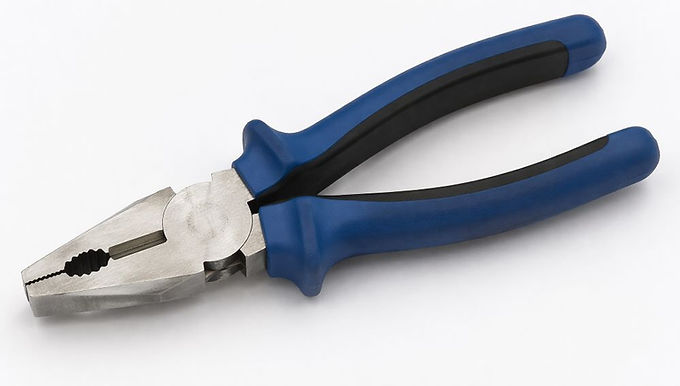
Close-up of lineman's pliers jaws and cutting edge (concept image)
Key Specs
Spec | Detail |
Length | 9 inches |
Design | High-leverage side-cutting |
Cutting Capacity | ACSR, screws, nails, hardened wire |
Insulated | No (insulated version sold separately) |
Construction | Induction-hardened steel, hot-riveted joint |
Country of Origin | Made in USA |
Price Range
$38 – $45
Pros
- Industry-standard tool — widely regarded as the benchmark for lineman's pliers
- 46% more cutting/gripping leverage than standard plier designs
- Cuts hardened wire and ACSR that standard pliers can't handle
- Made in USA with a lifetime warranty on material defects
Cons
- Non-insulated — not rated for use near live circuits
- General-purpose cutter, not suited for precision low-voltage/electronics wire
FAQ
Q. Are these insulated?
A. No, this is the non-insulated version. Klein sells an insulated model (D2000-9NE-INS) for work near live circuits.
Q. Can these cut ACSR (aluminum conductor steel-reinforced cable)?
A. Yes, that's one of the specific materials this model is rated to cut cleanly.
Q. Are these good for a beginner's first tool bag?
A. Yes — the versatility (cutting, gripping, twisting) makes it one of the most commonly recommended first "real" tools.
Related Products

BLUETTI AC180 Portable Power Station (1,152Wh)
BLUETTI

EF ECOFLOW Solar Generator DELTA 3 Classic with 220W Solar Panel
EcoFlow

Klein Tools D2000-9NE High-Leverage Lineman's Pliers (9-Inch)
Klein Tools

Klein Tools 11063W Automatic Wire Cutter/Stripper (8-20 AWG)
Klein Tools

Jackery Explorer 1000 v2 Portable Power Station (1070Wh, 1500W)
Jackery

Renogy 200W Portable Solar Panel, N-Type Foldable Solar Charger for Power Stations
Renogy

Amazon Echo Dot Max (Newest Model), Alexa Speaker with Room-Filling Sound
Amazon

Amazon Echo Show 8 (Newest Model), 8.7" Smart Display with Alexa+
Amazon

Klein Tools NCVT1P Non-Contact Voltage Tester Pen (50V-1000V AC)
Klein Tools

Klein Tools CL120 Digital Clamp Meter, Auto-Ranging 400A AC
Klein Tools

Klein Tools MM420 Digital Multimeter, Auto-Ranging TRMS (600V AC/DC)
Klein Tools

Scotch Super 33+ Vinyl Electrical Tape (3/4 in x 66 ft, Black)
Scotch (3M)

Ideal Electrical Wing-Nut Wire Connector 30-452, Red, Copper (Pack of 100)
IDEAL Electrical

Kasa Smart Wi-Fi Dimmer Switch HS220
Kasa Smart (TP-Link)

Lutron Maestro LED+ Dimmer Switch (150W, White)
Lutron

Feit Electric A19 Smart Wi-Fi LED Bulb (Color Changing, 6-Pack)
Feit Electric

Cree Lighting Basic A19 60W Equivalent LED Bulb (800 Lumens, 4-Pack)
Cree Lighting

First Alert HOME1-2 Standard Home Fire Extinguisher (2-Pack)
First Alert

First Alert CO606 Plug-In Carbon Monoxide Detector with Battery Backup
First Alert

GOOTOP Bug Zapper Outdoor Electric Mosquito Zapper
GOOTOP

Feit Electric Triple-Head Solar Security Flood Light (3000 Lumens)
Feit Electric

LEPOWER 1600LM Solar Security Light (3-Head, White)
LEPOWER

Good Earth Lighting Hyper Bright LED Motion Security Flood Light (2000/7000 Lumens, Selectable White)
Good Earth Lighting

Beyond Bright LED Ultra-Bright Garage Light
Beyond Bright (Ontel)

Artika Famous Optical LED Pendant Light (Chrome/Silver Ring)
Artika

Artika Vivaldi Big LED Pendant Light (5 CCT, Black)
Artika

Honeywell Home X8S Smart Thermostat
Honeywell Home

Ecobee Smart Thermostat Enhanced
Ecobee

Google Nest Learning Thermostat (3rd Gen)
Google Nest

DYMO LabelManager 160 Portable Label Maker
DYMO

Govee Table Lamp 2 Pro x Sound by JBL
Govee

Himalayan Glow Galaxy Lamp (16 Colors)
Himalayan Glow

Ring Floodlight Cam Wired Plus
Ring