
California Level 2 EV Charger Rebates 2026: How to Apply, Income Limits, Costs, and 30C Tax Credit Rules
- Mar 23
- 11 min read
Updated: Apr 4
If you're thinking about installing a Level 2 EV charger at home this year, you're not alone.
Gas prices are still high, electricity rates are manageable with Time-of-Use plans, and charging at home can cost as little as 1/3 of public stations.
But the upfront cost — $500–$1,500 for the charger plus $500–$3,000+ for wiring and possible panel upgrade — makes many homeowners hesitate.
The good news?
In 2026, many California homeowners may be able to stack utility rebates, income-qualified incentives, and — if their home is in an eligible low-income or non-urban census tract — the federal 30C EV charger tax credit to reduce installation costs significantly.
One of the most important rules many homeowners miss is that the federal 30C tax credit is location-based, not income-based. For personal-use charging equipment, the charger must generally be installed at your main home and in an eligible low-income or non-urban census tract.
Whether you're in PG&E, SCE, LADWP, or another territory, there are real dollars available right now.
This guide explains how to apply for California Level 2 EV charger rebates in 2026, who qualifies, key income limits, expiration dates, available benefits, and common mistakes to avoid.
By the end, you'll know if you can get your charger for under $500 out-of-pocket — or even free if you meet income limits.
What is the California EV charger rebate in 2026?

California EV charger rebates in 2026 are financial incentives offered by utilities and local programs that can reduce Level 2 home charger installation costs by $500 to over $4,000.

Eligible homeowners may also qualify for the federal 30C tax credit (30% up to $1,000) if their property is located in a qualifying census tract.
Table of Contents
What Is a Level 2 EV Charger and Why Do You Need One?
How to Apply for California Level 2 EV Charger Rebates in 2026 (Step-by-Step)
Who Qualifies? Eligibility Requirements & Income Limits
What Are the Benefits and How Much Money Can You Save?
Cost of Level 2 EV Charger Installation with Rebates (Real Numbers)
Practical Tips for Level 2 EV Charger Installation in California
Federal 30C Tax Credit vs. State/Utility Rebates – Comparison
FAQ
Conclusion
Related Posts
What Is a Level 2 EV Charger and Why Do You Need One?
A Level 2 EV charger, also called EVSE (Electric Vehicle Supply Equipment), uses a 240-volt circuit to charge your electric vehicle much faster than a standard 120V wall outlet.
In practical terms, most Level 2 chargers deliver about 3–19 kW of power and can add roughly 20–60 miles of driving range per hour, depending on your vehicle, charger settings, and home electrical capacity. That means many EV owners can plug in after dinner, sleep through the night, and wake up to a battery that is fully charged or close to it.
By contrast, Level 1 charging can take 20 hours or more for a full recharge, which is often too slow for households that drive daily.
For California homeowners, a Level 2 EV charger is not just a convenience upgrade. It can also be a practical money-saving improvement. Home charging is usually cheaper than relying on public fast chargers, especially if you use a Time-of-Use electricity plan and schedule charging during off-peak hours.
Smart chargers make this even easier by letting you automate charging times from a mobile app. On top of that, a professionally installed Level 2 charger can help future-proof your home as EV adoption continues to grow.
If you plan to stay in your house for years, or if you want your property to appeal to future EV-driving buyers, installing a Level 2 charger can be one of the most useful electrical upgrades you make.
For busy households, the biggest advantage is often not just cost savings, but the simplicity of waking up each morning with a charged vehicle and no need to stop at a public station.
How to Apply for California Level 2 EV Charger Rebates in 2026 (Step-by-Step)
Most California EV charger incentives are not issued through one single statewide rebate program. Instead, they usually come from local utilities, municipal utilities, or air-quality agencies.
That means the application process can vary depending on whether you are in PG&E, SCE, LADWP, Anaheim Public Utilities, Alameda Municipal Power, or another service territory.
The first step is to identify your utility and go directly to its official EV rebate or transportation electrification page. From there, confirm whether the program is still open, whether it is first-come-first-served, and whether you need to apply before installation or only after the charger is installed.
Next, verify the equipment rules. Some programs only cover approved Level 2 chargers, while others prefer hard-wired installations or smart chargers with Wi-Fi connectivity and load management features.
After that, get quotes from licensed California electricians and make sure the proposals include all real costs, such as permit fees, wire runs, breaker work, trenching if necessary, and potential panel upgrades.
Once the installation is complete, keep everything: the invoice, permit, inspection approval, charger model information, before-and-after photos, and proof of utility account ownership.
A complete application usually gets processed much faster. Many homeowners lose time not because they are denied, but because they submit incomplete paperwork or choose equipment that does not meet program rules.
To make the process easier, think of the application in three parts: confirm the program, complete the installation correctly, and submit every required document. While each utility program is slightly different, most follow a similar structure, so understanding this general process will help you avoid common delays.
Most rebates come from your local utility (PG&E, SCE, LADWP, etc.), not a single statewide program like the old CVRP. Here's the practical process:
Check your utility program – Visit your utility’s official EV page and confirm whether the rebate is still open.
Confirm charger eligibility – Make sure the charger model and installation type meet program rules.
Get licensed installation quotes – Request quotes that include permits, wiring, and possible panel upgrades.
Submit complete documents – Upload invoices, photos, permit records, and any income-related paperwork if required.
Track rebate status – Follow up with your utility if processing takes longer than expected.
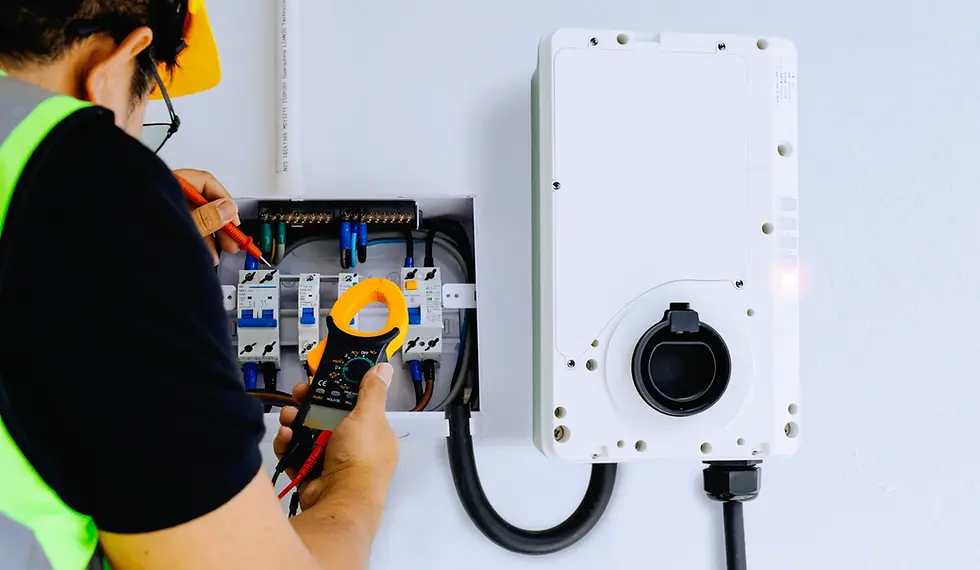
Important Safety Note: Never DIY a Level 2 install — it involves 240V circuits and can void warranties or create fire hazards. Always hire a licensed electrician and pull permits. California Electrical Code and NEC requirements must be followed.
Who Qualifies? Eligibility Requirements & Income Limits
Eligibility for California Level 2 EV charger rebates typically starts with a few basic requirements.
You usually need to be an active residential electricity customer, install the charger at your primary residence, use qualifying equipment, and complete the work in compliance with electrical code and permit requirements.
Some programs also require enrollment in a Time-of-Use rate plan, while others offer larger rebate amounts if you choose a networked charger that can support grid-responsive charging. If you live in a multifamily property, the rules may be different, and some programs may apply through the property owner or building operator rather than the tenant.
Income limits matter for many utility or regional rebate programs because the biggest incentives are often targeted toward lower-income households or disadvantaged communities.
That said, the federal 30C EV charger tax credit works differently from most local rebates. It is not primarily an income-based rule for personal installations. Instead, the home charging equipment generally must be installed at your main home and in an eligible low-income or non-urban census tract.
That is a very important distinction because many readers assume the federal credit is available statewide to everyone, which is not the case. If your income is above local rebate thresholds, you may still qualify for some base utility incentives, but for the federal credit you should verify your exact address before counting on it.
Basic requirements (most programs):
Active residential electric account in California
Installing at your primary residence (some multifamily also qualify)
Using approved Level 2 charger (hard-wired preferred)
Comply with local building codes and permits
Income Limits — Many programs are income-qualified for bigger rebates:
PG&E: Offers a base rebate in some cases, with additional support for income-qualified households depending on current program rules.
SCE: May provide stronger support for installation costs or panel upgrades for qualifying customers.
LADWP: Often combines a base rebate with an additional low-income bonus.
SCAQMD: Focuses more heavily on low-income households and qualifying communities.
If your income is higher, you may still qualify for base rebates and the federal tax credit (no income limit for 30C in eligible areas).
Expiration / Funding Note: Many utility programs run “while funds last” or through 2026. The federal 30C Alternative Fuel Vehicle Refueling Property Credit (30% of cost, up to $1,000 residential) requires the charger to be “placed in service” (installed and operational) by June 30, 2026. After that, it disappears unless extended.
What Are the Benefits and How Much Money Can You Save?
One of the biggest benefits of installing a Level 2 EV charger at home in California is convenience, but the long-term financial savings can also be meaningful.
If you charge at home using off-peak electricity, your effective driving cost per mile can be significantly lower than using public fast chargers on a regular basis. For many households, that means lower day-to-day transportation costs, less time spent waiting at stations, and much more predictable monthly energy spending.
A household looking at a $2,000 installed cost, for example, can immediately understand how a $500 utility rebate plus a potential 30% federal credit might reduce net out-of-pocket cost—if the property meets 30C location rules.
There are also non-financial benefits that matter in a California-focused article.
Charging at home overnight is easier than depending on public infrastructure, especially for families with work commutes, school pickups, or weekend driving routines.
A smart Level 2 setup can also pair well with rooftop solar or a battery system if the homeowner already has those upgrades or plans to add them later.
Key Benefits:
Lower charging cost: ~$0.10–$0.25/kWh at home vs. $0.40–$0.60+ at public DC fast chargers.
Convenience: Charge while sleeping — no more gas station stops.
Environmental: Supports California’s clean grid and reduces tailpipe emissions.
Property value: In some markets, homes with EV chargers may be more attractive to future buyers, especially in EV-friendly areas.
Stackable incentives: Utility rebate + federal tax credit + possible panel upgrade help.
Real Savings Examples (2026 estimates):
Charger + install: $2,000 total → PG&E base $500 rebate + federal $600 (30%) = net ~$900.
Income-qualified SCE customer needing panel upgrade: Up to $4,200 covered → net cost near zero.
LADWP low-income: Up to $1,500 total rebate.
In favorable driving and utility-rate conditions, some homeowners may recover their costs in just a few years through fuel savings alone.
Cost of Level 2 EV Charger Installation with Rebates (Real Numbers)
Typical breakdown without incentives:
Charger hardware: $400–$1,200
Wiring & labor: $500–$2,500 (depends on distance from panel)
Panel upgrade (if needed, 100–200A): $1,500–$4,000+
Permit & inspection: $100–$300
With rebates: Net cost can drop to $0–$1,500 for most. Always get 3 quotes — I’ve seen the same job vary by $1,000+ depending on electrician experience with EVs.
The final price often depends more on the installation conditions than on the charger itself. A short wire run in an attached garage is much cheaper than a long run to a detached garage or a project that requires a panel upgrade.
Practical Tips for Level 2 EV Charger Installation in California
A smoother EV charger project usually starts with planning, not with buying equipment. Many homeowners make costly mistakes early by choosing a charger too soon, overlooking panel limitations, or missing rebate requirements that could significantly reduce costs.
Check your panel first — Many older California homes have 100A or 150A panels. A Level 2 charger may require upgrade. Get a load calculation done early.
Go smart & Wi-Fi — Most programs give higher rebates for networked chargers that support demand response and TOU scheduling.
Combine with solar + battery — If you have or plan solar, add a home battery (like Powerwall) for even lower effective charging costs and backup power.
Apply early — Funds can run out mid-year. Don’t wait until summer.
Document everything — Take before/after photos, keep all receipts, and submit complete applications to avoid delays.
Safety first — Use only UL-listed equipment. Ensure proper grounding and GFCI protection where required. Overloaded circuits cause fires — don’t risk it.
Federal 30C Tax Credit vs. State/Utility Rebates – Quick Comparison
Incentive | Amount (Residential) | Income Limit? | Expiration | Covers Installation? | Stackable? |
Federal 30C Tax Credit | 30% up to $1,000 | No (but location-based: low-income or rural tracts) | June 30, 2026 | Yes | Yes |
PG&E Charger Rebate | Up to $500 + panel up to $2,000 | Yes (often <80% AMI) | While funds last | Yes | Yes |
SCE Charge Ready | Up to $1,500 install + $4,200 panel (income-qualified) | Yes | Through 2026 | Yes | Yes |
LADWP | Up to $1,500 (incl. low-income bonus) | Partial | Ongoing | Yes | Yes |
SCAQMD (SoCal) | Up to $500 (low-income) | Yes | Funds-based | Hardware mainly | Yes |
Utility rebates reduce your cost at the local level, while the federal 30C credit may reduce your tax burden later if your address and installation qualify.
Best Strategy: first confirm whether your address qualifies for the federal 30C credit, then apply for any utility rebate and keep all receipts, permits, and installation records for tax filing.
FAQ
Q: Can I apply for a California EV charger rebate after I already installed the charger?
A: Some California utility programs allow post-installation applications, but others require approval before purchase or installation. Always read the current program rules carefully before starting the project.
Q: Does every California homeowner qualify for the federal 30C EV charger tax credit in 2026?
A: No. Eligibility is not automatic. Homeowners should confirm whether their address and installation meet the applicable federal rules before counting on the credit.
Q: Which California utility offers the highest EV charger rebate in 2026?
A: The rebate amount depends on your utility provider and eligibility. Some utilities offer higher incentives for income-qualified households or panel upgrades, so it’s important to compare programs based on your specific service area.
Q: What documents do I need to apply for a Level 2 EV charger rebate in California?
A: Most rebate programs ask for a recent utility bill, charger invoice, installation photos, permit or inspection records, and sometimes proof of income or enrollment in a qualifying assistance program.
Q: How much does a Level 2 EV charger installation usually cost in California before rebates?
A: Most homeowners can expect a total installed cost ranging from about $1,000 to $4,000+, depending on charger model, wire distance, labor complexity, and whether a panel upgrade is required.
Q: Will I need a panel upgrade to install a Level 2 EV charger at home?
A: Not always. However, older homes with limited panel capacity may need load calculations, breaker upgrades, load management equipment, or a full panel upgrade.
Q: Are hard-wired Level 2 chargers better than plug-in models for rebate programs?
A: In many cases, yes. Hard-wired chargers are often preferred because they can offer better safety, cleaner installation, and stronger compatibility with some rebate requirements.
Q: How long does it usually take to receive a California EV charger rebate?
A: Processing times vary by utility and program, but many homeowners receive their rebate in about 4 to 8 weeks after submitting a complete application.
Q: Can renters or apartment residents qualify for EV charger incentives in California?
A: Sometimes. Multifamily properties may qualify through separate programs, but renters often need landlord approval and may face different application requirements than single-family homeowners.
Q: Can I combine a California EV charger rebate with solar, battery, or panel upgrade incentives?
A: In some cases, yes. Depending on your utility and local program rules, you may be able to combine EV charger incentives with other home electrification or panel upgrade support.
Q: What is the cheapest way to install a Level 2 EV charger at home in California in 2026?
A: The lowest-cost projects usually involve a short wire run, no panel upgrade, an approved charger model, and a utility rebate that reduces the total out-of-pocket cost.
Conclusion
Installing a Level 2 EV charger in California in 2026 can be a smart upgrade, especially if you qualify for utility rebates or other local incentives. The key is to understand your true installation cost, check program eligibility carefully, and plan ahead before funds run out.
Before making a purchase, compare your utility’s current rebate rules, confirm your installation costs, and keep all paperwork organized so you can maximize any incentives you qualify for.
Related Posts
Best 7 Level 2 EV Chargers for Home in 2026 (Cost & Reviews)
Electrical Panel Upgrade for Solar & EV in California (2026)
Solar Installation Guide in California (2026): Costs and Process
Solar Battery Costs in California 2026: Price Breakdown
Zero-Down Solar Financing in California 2026: Lease, PPA, and Loan
Safety Disclaimer: This is general guidance based on publicly available 2026 program information. Programs change and funding can run out. Always verify directly with your utility or the administering agency. For electrical work, consult a licensed California C-10 electrician and follow all local codes. Professional installation is strongly recommended, and all electrical work should comply with applicable codes and permit requirements. This is not financial or legal advice.
About the author
James Ree has hands-on experience in electrical materials, renewable energy equipment, and residential energy projects. He writes practical guides on solar, EV charging, batteries, and home electrical upgrades for U.S. homeowners.
Disclaimer
Costs, rebates, and local rules can change, so it is always a good idea to confirm details with your utility company and a licensed installer before moving forward.


