
Why Your EV Charging Cost Is So High in California 2026 (And 5 Ways to Fix It)
Updated: Apr 30
My first week driving an EV, I plugged into a standard 120V outlet in the garage and didn't think much about it. The car charged slowly — nearly 20 hours for a full battery — but it got there. Then the electricity bill came.
The increase wasn't catastrophic, but it was higher than I expected. And here's the embarrassing part: at the time, I was supplying solar and electrical equipment to installers across Los Angeles for a living. I knew exactly how California's electricity rates worked. I knew what TOU pricing was. I just hadn't applied any of it to my own situation.
The reason was simple — I was renting a house. Not my panel, not my roof, not my call. I couldn't add a dedicated 240V circuit for a Level 2 charger without the landlord's approval, and I wasn't in a position to push for it. So I used the 120V outlet in the garage and accepted the slow charge.
In 2026, California's average residential electricity rate has reached 34–38¢/kWh in most utility territories (California Energy Commission, 2025 residential rate data). At those rates, an EV owner who charges at the wrong time of day can easily pay twice what they would with a small scheduling adjustment — no hardware change required.
This guide covers exactly why EV charging bills run higher than expected in California in 2026 — with specific numbers from actual utility rate structures — and the five adjustments that make the most measurable difference.
Quick Answer:

Charging an EV in California in 2026 typically costs $43–$180/month for a driver covering 12,000 miles per year.

The single biggest variable isn't the car or the charger — it's whether you're charging during peak or off-peak hours.

At SCE's peak rate (38–45¢/kWh) versus off-peak (15–22¢/kWh), the difference on the same driving distance is roughly $600–$900 per year.
Table of Contents
What EV Charging Actually Costs in California in 2026 — The Real Numbers
Reason #1: You're Charging During Peak Hours Without Realizing It
Reason #2: Level 1 Charging Is Costing You More Than You Think
Reason #3: You're Not on the Right Rate Plan
Reason #4: You're Underestimating How Much Your EV Actually Uses
Reason #5: No Solar or Battery Integration
Fix #1: Switch to Off-Peak Charging — The Easiest $400–$900 Annual Saving
Fix #2: Upgrade to a Level 2 Charger
Fix #3: Switch to a TOU Rate Plan Built for EV Owners
Fix #4: Pair Charging With Solar Self-Consumption
Fix #5: Monitor and Adjust With a Smart Charger
FAQ
Conclusion
Related Posts
What EV Charging Actually Costs in California in 2026 — The Real Numbers
Before identifying what's driving your bill up, it helps to know what the numbers should look like.
Base calculation for a typical California EV owner:
Annual miles: 12,000
Vehicle efficiency: approximately 3.0–3.5 miles/kWh (most mainstream 2024–2026 EVs)
Annual charging demand: approximately 3,430–4,000 kWh
Monthly charging demand: approximately 286–333 kWh
Monthly cost at different California electricity rates:
Rate Scenario | Rate (¢/kWh) | Monthly Cost | Annual Cost |
SCE off-peak (midnight–6 AM) | 15–22¢ | $43–$73 | $516–$876 |
PG&E off-peak (11 PM–7 AM) | 18–24¢ | $51–$80 | $612–$960 |
Blended average (mix of peak and off-peak) | 30–34¢ | $86–$113 | $1,032–$1,356 |
SCE peak (4–9 PM) | 38–45¢ | $109–$150 | $1,308–$1,800 |
LADWP standard residential | 22–28¢ | $63–$93 | $756–$1,116 |
Source: SCE TOU-D-PRIME rate schedule, PG&E EV2-A rate schedule, LADWP residential rate schedule (2025–2026 effective rates).
The range between the cheapest and most expensive scenario is striking: $516 versus $1,800 annually — a $1,284 difference on the same car driving the same distance. That's the financial stakes of charging optimization in California in 2026.

Reason #1: You're Charging During Peak Hours Without Realizing It
This is the most common and most expensive mistake California EV owners make. It's also the most invisible — most people plug in when they get home, which happens to be exactly when California's grid is most stressed and electricity is most expensive.
When peak hours typically fall:
SCE (Southern California Edison): 4 PM – 9 PM daily
PG&E (Pacific Gas & Electric): 4 PM – 9 PM weekdays
LADWP (Los Angeles): 10 AM – 8 PM weekdays, 10 AM – 5 PM weekends (varies by plan)
SDG&E (San Diego Gas & Electric): 4 PM – 9 PM daily
If you get home at 6 PM and plug in immediately, you're charging at the highest rate of the day. For an EV that needs 40 kWh to reach a full charge, that session at SCE's peak rate of 41¢/kWh costs $16.40. The same session at the off-peak rate of 18¢/kWh costs $7.20. That's $9.20 difference on a single charging session — and if it happens most nights, the annual cost difference exceeds $3,000.
Most EV owners don't realize this is happening because the car shows "charging" regardless of when it's plugged in, and the electricity bill is a monthly total that doesn't break down by time of use.
Reason #2: Level 1 Charging Is Costing You More Than You Think
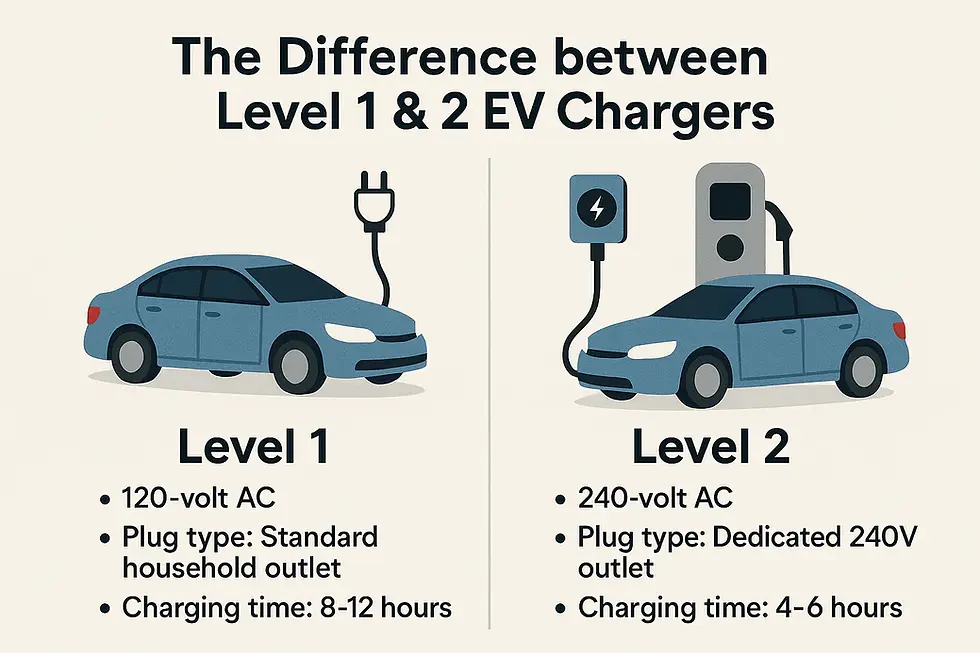
Level 1 charging — plugging into a standard 120V household outlet — has two financial problems that most owners don't account for.
I used Level 1 myself when I was renting, because I had no choice — adding a 240V circuit wasn't an option without the landlord's sign-off. But knowing where the costs come from would have helped me plan around them better.
Problem 1: Charging losses.
All EV charging involves some energy loss in the conversion from AC grid power to DC battery storage. Level 1 charging is less efficient than Level 2 — the conversion losses are higher because the lower-voltage, lower-current charging process runs for many more hours. Industry estimates put Level 1 efficiency at approximately 85–88%, versus Level 2 at 90–94%. On a 3,600 kWh annual charging demand, that 5–9% difference adds 180–324 kWh of wasted electricity per year — approximately $54–$110 at California rates that you're paying for energy that never made it into the battery.
Problem 2: Charging duration and peak hour exposure.
A Level 1 charger adds roughly 3–5 miles of range per hour. For a driver who depletes 40–50 miles of range daily, a Level 1 session can run 8–15 hours. If you plug in at 6 PM, Level 1 charging is still running at 2 AM — but it also ran through the entire 4–9 PM peak window. A Level 2 charger at 30+ miles/hour would complete the same session in 90 minutes, well within the off-peak window.
The combination matters:
Level 1 owners tend to pay more per kWh (longer exposure to peak hours) and pay for more kWh (higher conversion losses). Both go the wrong direction.
For a comparison of Level 2 charger options with current California pricing, Best 7 Level 2 EV Chargers for Home in 2026 (Cost & Reviews) covers the specific models and what installation typically costs.
Reason #3: You're Not on the Right Rate Plan
Most California homeowners start on a standard tiered residential rate. That rate structure wasn't designed for EV owners and penalizes high-volume electricity users by charging more as usage increases. Adding 3,600 kWh of annual EV demand to a household that was already in a high tier can push the marginal cost of every EV kilowatt-hour to 40¢ or more.
The alternative is a Time-of-Use (TOU) rate plan specifically designed for EV owners. Every major California utility offers at least one:
SCE: TOU-D-PRIME (EV-specific plan) — off-peak rates as low as 15–18¢/kWh
PG&E: EV2-A — off-peak as low as 18–22¢/kWh; also EV-B for dedicated metering
LADWP: EV Time-of-Use — off-peak as low as 14–20¢/kWh depending on season
SDG&E: EV-TOU — off-peak rates comparable to SCE and PG&E
Switching to an EV-specific TOU plan and charging during the off-peak window typically saves $400–$900 per year for a driver covering 12,000 miles annually. This is often the single highest-impact change an EV owner can make without spending anything on hardware.
The timing strategy that makes TOU rates work is covered specifically in Best Time to Charge Your EV at Home in California (2026): NEM 3.0 Rates, Cheapest Hours & Real Savings.
Reason #4: You're Underestimating How Much Your EV Actually Uses
EV efficiency varies more than most owners realize, and the EPA combined efficiency rating for most vehicles is measured under controlled conditions that don't always reflect California driving.
Factors that reduce real-world EV efficiency:
Air conditioning: Running AC in California summer heat reduces range by 15–25%. If your EPA rating assumes moderate climate use, your summer kWh/mile is likely higher than the sticker suggests.
Highway speed: Most EVs are most efficient at 35–55 mph. Freeway driving at 65–75 mph increases energy consumption by 20–35%.
Fast charging losses: DC fast charging (public stations) is less efficient than home Level 2 charging — approximately 85–90% efficiency versus 90–94% at home. If you rely on public fast charging even occasionally, your effective energy cost per mile includes those losses.
Cold weather: Less relevant in Southern California but meaningful for Bay Area and mountain residents — battery heating in cold conditions can reduce efficiency by 20–40%.
A driver who calculates their EV costs based on EPA efficiency and California average electricity rates may be underestimating actual costs by 20–35%. Building that margin into cost expectations prevents bill surprises.
Reason #5: No Solar or Battery Integration
Under California's NEM 3.0 structure (CPUC Decision 22-12-056, effective April 2023), rooftop solar systems earn approximately 2–8¢/kWh for exported electricity. But avoiding that export by charging an EV directly from solar during peak production hours (10 AM–4 PM) avoids buying electricity at 30–45¢/kWh during evening peak. That's a self-consumption value of 30–45¢/kWh versus an export value of 2–8¢/kWh — a difference that makes solar-direct EV charging one of the highest-value uses of rooftop solar in California today.
For EV owners without solar: a home battery can charge during off-peak hours (15–22¢/kWh) and supply the EV during evening peak (avoiding 38–45¢/kWh grid draws). The math on battery economics under NEM 3.0 is covered in detail in Solar Battery Costs in California 2026: Price Breakdown.
A note for renters:
When I was renting, I didn't seriously consider solar because I assumed the roof was the only option. What I didn't think about until later was the backyard — it was large enough for ground-mounted panels with no roof modification and no permanent structural change to the property. For a single EV driving 12,000 miles annually (approximately 3,600 kWh), a 3–4 kW ground-mounted setup can cover a meaningful portion of that demand. The regulatory environment at the time made plug-in solar impractical in California — but SB 868 is changing that. Balcony Solar for California Renters 2026: SB 868, Costs & How Much You'll Actually Save covers what's currently possible for renters and where the legislation stands.
For EV owners evaluating whether adding solar specifically to offset charging costs makes sense, Best Solar System Size for EV Owners in California 2026 walks through the sizing calculation for the combined household and EV load.
Fix #1: Switch to Off-Peak Charging — The Easiest $400–$900 Annual Saving
This is the highest-impact, zero-cost change available to most California EV owners.
What to do:
Most EVs have a built-in charging scheduler — set it to begin charging after 9 PM (or whenever your utility's off-peak period starts) and complete before 6–7 AM. If your EV doesn't have this feature, most Level 2 smart chargers (ChargePoint, Emporia, Wallbox) have scheduling built into their app.
What it saves:
At SCE rates, shifting from peak (41¢/kWh average) to off-peak (18¢/kWh average) on 300 kWh/month of EV charging reduces the monthly charging bill from approximately $123 to $54 — a $69/month saving, or $828/year. At PG&E rates the savings are similar.
One thing to watch:
If you're on a standard tiered rate rather than a TOU plan, scheduling charging at midnight doesn't automatically give you the lower rate — you need to switch to a TOU plan first (Fix #3 below). Scheduling charging without switching plans saves some money through reduced peak demand, but the full rate benefit requires the plan change.
Fix #2: Upgrade to a Level 2 Charger
The financial case for a Level 2 charger upgrade is straightforward: faster charging reduces peak hour exposure, lower conversion losses mean fewer wasted kWh, and the ability to time charging precisely improves TOU optimization.
Typical costs in California in 2026:
Charger hardware: $300–$700 (mid-range networked charger)
Installation (dedicated 40A circuit, permit): $600–$1,500 depending on panel distance and complexity
Total: $900–$2,200
Payback calculation:
If a Level 2 upgrade saves $400–$800 per year through efficiency gains and better peak-avoidance timing, the payback period is typically 1.5–4 years. For homeowners who also qualify for a Level 2 charger rebate from their utility (PG&E, SCE, LADWP all offer programs), that payback can be under 2 years.
For a full guide to Level 2 charger rebates and how to apply in California, Level 2 EV Charger Rebates in California 2026: How to Apply covers current program details by utility territory.
Before installing a Level 2 charger, confirm your electrical panel has the capacity for a 40A dedicated circuit. Many California homes built before 1990 have 100A service panels that may need an upgrade. Electrical Panel Upgrade for Solar & EV in California (2026) covers that decision in detail.
Fix #3: Switch to a TOU Rate Plan Built for EV Owners
Contact your utility and request to be moved to their EV-specific Time-of-Use rate plan. This is typically done online through the utility's account portal and takes effect within 1–2 billing cycles. There's no hardware cost.
Which plan to request:
SCE customers: TOU-D-PRIME
PG&E customers: EV2-A (or EV-B if you want a separate EV meter)
LADWP customers: EV Time-of-Use rate
SDG&E customers: EV-TOU-5
One consideration:
TOU plans work in your favor when you can reliably charge during off-peak hours. If your schedule means you regularly need to charge in the late afternoon or early evening, the peak-rate penalties could outweigh the off-peak savings. Run the numbers on your actual charging pattern before switching — most utility websites have online calculators for this.
Fix #4: Pair Charging With Solar Self-Consumption
For homeowners with solar or considering it, aligning EV charging with solar production is the highest-value use of rooftop solar under NEM 3.0.
How it works:
If you can charge during the day — because you work from home, leave the car parked at home during daylight hours, or have a programmable charging schedule — your EV draws directly from solar production rather than the grid. Under NEM 3.0, that solar energy would otherwise be exported at 2–8¢/kWh. Using it for EV charging instead avoids purchasing electricity at 30–45¢/kWh during the evening — a self-consumption benefit of roughly 25–40¢ per avoided kWh.
What it saves:
For an EV using 300 kWh/month, shifting even 50% of charging to solar self-consumption (150 kWh/month) saves approximately $45–$60/month at avoided peak rates — $540–$720 annually from this single change.
If you can't charge during the day:
A home battery stores daytime solar production for nighttime EV charging. This captures the same self-consumption benefit regardless of when you drive or plug in. The economics of home battery storage under NEM 3.0 are covered in NEM 3.0 California Explained (2026): Solar Costs, Battery Savings & Is It Still Worth It?.
Fix #5: Monitor and Adjust With a Smart Charger
A smart Level 2 charger with energy monitoring does two things that make a measurable difference: it shows exactly when and how much your EV is consuming, and it automates the scheduling and rate-optimization that most owners do inconsistently.
What to look for in a smart charger:
TOU scheduling: automatically charges during the lowest-rate window
Solar integration: adjusts charging based on real-time solar production (relevant for Emporia, Wallbox, and some ChargePoint models)
Consumption monitoring: shows kWh used, cost per session, and monthly totals
Demand response: some California utilities offer bill credits for enrolling smart chargers in demand response programs
Demand response credits:
SCE's Connected Solutions and PG&E's SmartAC programs offer bill credits for enrolling smart devices — including EV chargers — in demand response. When the grid is stressed (typically hot summer afternoons), the utility may pause or reduce your charging briefly. In exchange, you receive annual bill credits of $25–$75 depending on the program and enrollment tier. Not a large amount, but effectively free money for a setting you configure once.
FAQ
Q: What is the average monthly cost to charge an EV at home in California in 2026?
A: For a driver covering 12,000 miles per year, the typical range is $43–$150/month depending on when charging happens and which utility territory you're in. Off-peak charging on an EV-specific TOU plan puts most drivers in the $43–$80 range. Charging without TOU optimization — primarily during peak hours — can push costs to $130–$180/month on the same vehicle.
Q: Why is my EV charging bill higher than I expected in California?
A: The most common causes are charging during peak hours (4–9 PM on most California utilities), using Level 1 charging with its higher energy losses and longer peak-hour exposure, and remaining on a standard tiered residential rate rather than switching to an EV-specific TOU plan. In most cases, a combination of scheduling adjustment and rate plan switch resolves the majority of the overage.
Q: Is Level 1 or Level 2 charging cheaper for California home EV charging?
A: Level 2 is cheaper for most California EV owners on a TOU plan, primarily because faster charging completes sessions outside peak hours and has lower conversion losses. The hardware and installation cost ($900–$2,200) is typically recovered in 1.5–4 years through reduced electricity costs and utility rebates.
Q: How much can off-peak charging save me per year in California?
A: At SCE rates, shifting from peak (41¢/kWh) to off-peak (18¢/kWh) on approximately 3,600 kWh of annual EV demand saves approximately $828/year. At PG&E rates the savings are similar — roughly $700–$900 annually for a 12,000-mile-per-year driver.
Q: Can solar power significantly reduce EV charging costs in California in 2026?
A: Yes, particularly under NEM 3.0 where the value of self-consumed solar (avoided grid purchase at 30–45¢/kWh) is dramatically higher than the export credit (2–8¢/kWh). For EV owners who can align daytime charging with solar production, or who add battery storage to shift solar energy to evening charging, the effective per-kWh cost of EV charging can drop to near zero after the solar system's payback period.
Q: I'm renting — can I still reduce my EV charging costs in California?
A: Yes. Switching to a TOU rate plan and scheduling off-peak charging is available regardless of whether you rent or own, and costs nothing. That alone can save $400–$800 per year. Installing a Level 2 charger may require landlord approval, but the rate plan and scheduling changes don't.
If you have yard access, ground-mounted or portable solar options are also worth exploring — Balcony Solar for California Renters 2026: SB 868, Costs & How Much You'll Actually Save covers what's currently practical for renters.
Q: Should I get a separate EV meter from my utility?
A: PG&E's EV-B plan allows a separate sub-meter for the EV charger circuit, so EV charging is billed separately from household electricity at a different rate. This can be beneficial if household electricity usage puts you in a high tier — the EV portion is billed at the lower EV rate separately. Ask PG&E to run the numbers for your specific usage pattern before committing.
Q: How do I find out my current electricity rate and whether I'm on a TOU plan?
A: Log into your utility's online account portal and look for "Rate Plan" or "Current Rate." All major California utilities (SCE, PG&E, LADWP, SDG&E) show your current rate classification. From there, you can use the utility's rate comparison tool to estimate your bill under different plans based on your actual usage pattern.
Conclusion
The gap between what California EV owners expect to pay for charging and what they actually pay almost always comes down to the same variables: charging time, rate plan, and charger type.
At SCE's off-peak rate of 18¢/kWh versus the peak rate of 41¢/kWh, the same 12,000 miles costs either $648 or $1,476 per year — an $828 difference driven entirely by when the car is plugged in. That's the clearest version of the problem, and the fixes follow logically from it.
The five adjustments in order of cost and impact:
Schedule charging during off-peak hours — zero cost, up to $900/year saved
Switch to an EV-specific TOU rate plan — zero cost, required to realize Fix #1's full benefit
Upgrade to a Level 2 charger — $900–$2,200 upfront, $400–$800/year saved, 1.5–4 year payback
Align charging with solar self-consumption — highest long-term value for solar owners under NEM 3.0
Add a smart charger with scheduling and monitoring — automates and sustains the savings from all the above
For most California EV owners, Fixes #1 and #2 together — schedule change plus rate plan switch — are available immediately at no cost and deliver the majority of the potential savings. The hardware upgrades extend and deepen those savings over time.
If you're also evaluating whether adding solar to specifically offset EV charging costs makes sense for your household, Best Solar System Size for EV Owners in California 2026 walks through the combined sizing calculation with real numbers.
Related Posts
About the Author
James Ree has eight years of experience in electrical, HVAC, and solar wholesale in Los Angeles, supplying equipment to residential and commercial installers. He now writes practical guides on solar, EV charging, battery storage, and home electrical systems for U.S. homeowners.
Disclaimer
Electricity rates and utility programs change frequently. Verify current rate schedules directly with your utility before making decisions. Rate figures cited are based on 2025–2026 published tariff schedules for SCE, PG&E, LADWP, and SDG&E.


