
Can't Put Solar on Your Mobile Home Roof in California? A Carport Might Be Your Best Option
California Mobile Home Solar · 2026
By James Ree · ElecGuys
In eight years of supplying solar equipment to installers across Los Angeles, I watched the same conversation happen more times than I can count. A manufactured home owner calls a solar company. The rep pulls up satellite imagery, looks at the roof, and says no. Sometimes they say it nicely. Sometimes they just stop returning calls. Either way, the homeowner is left with a $230 electric bill and no path forward.
One call that stuck with me came from a contractor working in Fresno. His client was 71, on fixed income, living in a manufactured home she'd owned for 22 years. Her PG&E bill was hitting $230 in summer. Three companies had walked away after seeing the roof. The contractor called me asking if there was anything we could do. There was. She had a steel carport next to her home that had been sitting there doing nothing but shading her car. We put 14 panels on it. Her first summer bill after installation: $38.
That's what this guide covers. If you've been told no on rooftop solar for your mobile or manufactured home in California, a solar carport may be the most practical path to reducing your electricity bill — without touching your roof at all.
If you want to understand how the 2026 solar market looks for California homeowners broadly — including how the federal tax credit expiration changed the math — Is Solar Still Worth It in California 2026 Without the Federal Tax Credit? has the full picture.
Quick Answer
Most California installers decline mobile home rooftop solar because the roof structure handles only 3–5 lbs/ft² — far below the 20+ lbs/ft² a panel system requires.

A solar carport bypasses every one of those problems: it's a separate structure, permitted and engineered independently, and fully eligible for California's GoGreen Home financing program, which explicitly covers manufactured and mobile homes.

Total installed cost runs $8,500–$35,000 across three scenarios depending on what's already in your driveway.

Payback can be as short as 7 years under current PG&E, SCE, and SDG&E rates.
Table of Contents
Why Solar Companies Keep Saying No to Mobile Home Roofs
What Is a Solar Carport? (Plain-English Explanation)
Why a Solar Carport Often Outperforms Rooftop Solar
Three Real-Cost Scenarios: Which One Fits Your Situation?
Can You Finance a Solar Carport on a Mobile Home in California?
Reinforce or Rebuild? How to Decide Before You Spend a Dollar
Reinforce or Rebuild? The Real Cost Comparison
California-Specific Rules Before You Start
What a Complete Solar Carport Quote Should Look Like
FAQ
Conclusion
Related Posts
Why Solar Companies Keep Saying No to Mobile Home Roofs in California
It's not that installers don't want the work. There are six specific, concrete reasons they walk away — and understanding them is the first step toward finding an approach that actually works.
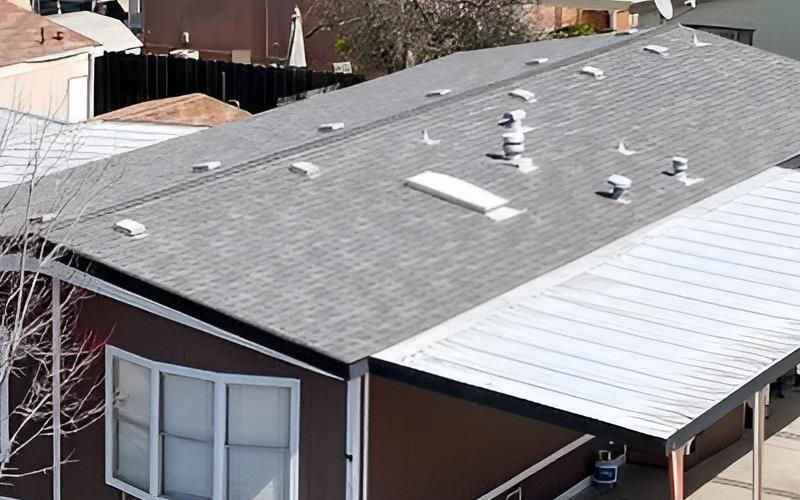
The fundamental issue is structural. Mobile home roofs are engineered to be lightweight and transportable, not to carry the distributed load of a solar array. Fixing that problem on the roof itself is expensive, slow, and legally complicated in California. A carport sidesteps all of it — because it's a different structure entirely.
# | Reason | What it means in practice |
01 — Roof load | Roof handles only 3–5 lbs/ft² | A 5 kW system adds 800–1,000 lbs of distributed load. Site-built home roofs handle 20+ lbs/ft². The math doesn't work, and no reputable installer will sign off on it without expensive structural remediation. |
02 — Framing | Rafters won't take lag bolts | Mobile home rafters are typically 2×2 or 2×3 lumber. Drilling lag bolts into them creates leak points and risks splitting the framing. This is a structural failure waiting to happen. |
03 — HCD permit | CA requires a structural engineer report | California's HCD mandates a signed report from a licensed CA structural engineer (SE license) before any roof modification on a manufactured home. That report costs $2,000–$5,000 and takes weeks — before a single panel goes up. |
04 — Insurance | Coverage gaps in CA fire zones | Adding roof penetrations triggers policy review. In Tier 2 and Tier 3 high-hazard fire zones — which cover large parts of California — some carriers require disclosure before covering a modified mobile home roof. |
05 — Park lease | Lease may prohibit roof modifications | Even if you clear structural and permitting hurdles, your park lease may prohibit exterior structural modifications without management approval — or entirely. Violations can trigger lease termination. |
06 — Installer gap | Experienced contractors are rare | Most C-46 solar contractors (verify at cslb.ca.gov) have never done a manufactured home rooftop job. The liability is higher, the permit path is slower, and the margin is thinner. They take three standard jobs in the time one mobile home rooftop project requires. |
None of these problems exist with a solar carport. A carport is an accessory structure — permitted, engineered, and insured separately from your home. Your roof stays untouched.
What Is a Solar Carport? (Plain-English Explanation)
If you've spent time in a mobile home park, you've already seen one. You just might not have known it was generating electricity.
A regular carport | A solar carport |
A roof on posts — no walls. Shades your car from sun and rain. Most are aluminum or steel, about 10×20 feet for one vehicle. One job: keeping your car cool. | Same structure — but the roof is solar panels instead of metal sheeting. It still shades your car. It also generates electricity from sunlight and sends it into your home. One structure, two jobs. |
Think of it as replacing the plain metal roof on a carport with panels that happen to make electricity. The frame, posts, and concrete footings are the same. The only difference is what's on top.
Here's how the electricity gets to your house. The panels collect sunlight and produce direct current (DC) power. An inverter — usually mounted on the carport post or your home's exterior wall — converts that to alternating current (AC), which is what your appliances run on. A wire runs from the inverter to your home's electrical panel. From there, it works identically to any other solar system.
For homeowners on fixed income:
A solar carport doesn't change anything about your home. No drilling into your roof. No modifications to your living space. It's a structure that sits next to your home — and it happens to make electricity.
Does my car have to be parked under it?
No. Panels generate power whether there's a car underneath or not. Some homeowners use the shaded space for outdoor seating or storage.
What happens at night?
Solar panels only generate power in sunlight. At night, you draw from the grid as normal — or from a battery if you add one. Under California's current NEM 3.0 policy (CPUC Decision 22-12-056), pairing with a battery significantly improves the financial case, since grid export credits are now only $0.05–$0.08/kWh while peak power costs $0.26–$0.80/kWh depending on your utility and time of day.
What if it rains?
Solar panels are fully weatherproof and designed to operate in all conditions. Rain actually provides a natural rinse that can help efficiency. Adding gutters to channel water away from the parking area is standard practice.
Why a Solar Carport Often Outperforms Rooftop Solar
Here's something most installers won't mention: even for homeowners whose roofs could technically hold panels, a carport frequently produces more electricity and costs less to maintain over time. The reasons are physics and access.
You control the angle.
Your roof pitch is fixed at whatever it was built at. A carport can be designed at the optimal 30–35° south-facing angle for California — boosting annual production by 10–25% compared to a suboptimal roof orientation.
Better airflow means better output.
Solar panels lose roughly 0.4% efficiency per 1°C above 25°C. A roof-mounted panel bakes against hot roofing material with no airflow underneath. A carport panel has open air on all sides — panels run 10–20°C cooler, which adds measurable production across a California summer.
Maintenance is cheaper and safer.
Cleaning or inspecting rooftop panels requires a ladder and safety equipment. Carport panels are accessible from the ground or a step stool — no service fee required for routine cleaning.
No roof penetrations, no future leak risk.
Every lag bolt through a roof is a potential leak point years from now. A carport introduces zero penetrations to your home.
Easier to move if you relocate.
A carport is a separate structure. If you ever move, reinstallation at a new location is a manageable project. Rooftop panels require full removal, roof patching, and reinstallation — often $2,500–$4,000 in labor alone.
Three Real-Cost Scenarios: Which One Fits Your Situation?
Your total cost depends almost entirely on what's already in your driveway. Here are the three situations I see most often, with numbers based on what California contractors are actually charging in 2026. All figures assume a 5 kW system — appropriate for a manufactured home with a $150–$250 monthly electric bill.
Not sure which scenario applies to you? Walk outside and knock on the carport post. Steel gives a hollow metallic ring. Wood sounds dull and flat. Thin aluminum flexes when you push it. That check tells you most of what you need to know before you call anyone.
Scenario A — No carport: building from scratch
You have a flat driveway or gravel pad and nothing overhead. Highest cost option, but maximum design flexibility — you pick the angle, orientation, and size from scratch.
Site survey, soil test, and permits | $800–$1,800 |
Concrete footings (4 posts, standard CA soil) | $2,000–$4,500 |
Steel frame, beams, purlins — materials | $3,000–$6,000 |
Structure assembly labor | $1,500–$3,500 |
Solar panels — 400W × 12–13 panels | $4,000–$6,500 |
String inverter (Enphase IQ8 or equivalent) | $1,000–$2,000 |
Electrical wiring and grid interconnect | $1,500–$3,000 |
Gutters, monitoring, final inspection | $500–$1,300 |
Contingency (10%) | $1,440–$2,860 |
Total estimated cost: $17,500–$35,000
Payback period: 12–18 years
Est. annual savings (PG&E): ~$1,400
Build timeline: 3–6 weeks
Scenario B — Existing carport: needs structural reinforcement
You have a lightweight wood or thin aluminum carport that wasn't built to carry panel weight. A structural engineer needs to assess it first — reinforcement scope is unknown until that report comes back.
Structural engineer inspection and report | $400–$1,200 |
Foundation anchoring or footing upgrades | $800–$3,000 |
Column, beam, or purlin replacement | $1,000–$4,000 |
New panel mounting rail system | $500–$1,200 |
Post-reinforcement permit and re-inspection | $200–$500 |
Solar panels — 400W × 12–13 panels | $4,000–$6,500 |
Inverter, electrical, and grid interconnect | $2,500–$5,000 |
Contingency (10%) | $940–$2,240 |
Total estimated cost: $10,340–$23,640
Payback period: 9–14 years
Est. annual savings (PG&E): ~$1,400
Build timeline: 2–4 weeks
Important for Scenario B:
Get the structural engineer report before committing to reinforcement. I've seen cases where the reinforcement quote came back higher than building a new steel carport from scratch. The $400–$1,200 inspection fee is money well spent before you're locked in.
Scenario C — Existing solid steel carport: ready to go ★
You have a steel carport that's already structurally sound — common in parks that installed them as standard features. An engineer confirms it can carry the load. You go straight to panel installation.
Structural engineer confirmation letter | $200–$500 |
Solar permit (local building department) | $150–$400 |
Mounting rails, clamps, and brackets | $600–$1,200 |
Mounting hardware installation labor | $400–$800 |
Solar panels — 400W × 12–13 panels | $4,000–$6,500 |
Inverter, electrical, and grid interconnect | $2,500–$5,000 |
Monitoring and final inspection | $300–$600 |
Contingency (5%) | $407–$750 |
Total estimated cost: $8,557–$15,750
Payback period: 7–11 years
Est. annual savings (PG&E): ~$1,400
Install timeline: 1–2 weeks
Can You Finance a Solar Carport on a Mobile Home in California?
Yes. The options differ from what a site-built homeowner would use, but they exist — and one of them is a state-backed program specifically designed for manufactured home owners that almost nobody in this community knows about.
2026 federal tax credit update:
The 30% residential solar tax credit (Section 25D) expired December 31, 2025 under the One Big Beautiful Bill. New installations in 2026 do not qualify. This makes financing structure more important than ever — there's no tax windfall to offset a high-interest loan. (Source: IRS.gov, April 2026)
Financing option | Mobile homes eligible? | 2026 rate | Key details |
GoGreen Home Program CA state-backed loan | Yes ✓ | Below market | Explicitly covers manufactured and mobile homes. Up to $75,000 / 20 years for bundled solar + battery. PG&E, SCE, SDG&E customers eligible. |
Solar-specific personal loan Credit Human, GoodLeap | Yes ✓ | 6–12% APR | Based on personal credit, not home equity. Works regardless of mobile home status. Can cover carport structure + panels if bundled in one installer quote. |
Solar lease / PPA LightReach, EnFin | Yes ✓ | $0 down | Installer owns the system. You pay a fixed monthly or per-kWh rate below your current utility rate. No ownership, no maintenance responsibility. Contract transfers if you move. |
HELOC / home equity loan Banks, credit unions | Conditional △ | 5–9% APR | Only if home is titled as real property AND you own the land. Park space renters: not available. |
PACE financing | No ✗ | 6.5–9% | Mobile homes explicitly excluded from California's R-PACE program. Not available regardless of land ownership status. |
GoGreen Home: the most underused option for manufactured home owners
California's GoGreen Home Energy Financing program — administered by CAEATFA (California Alternative Energy and Advanced Transportation Financing Authority) — is the single best financing tool available to manufactured home owners going solar. It was built specifically because this population has fewer financing options than site-built homeowners. Almost nobody in mobile home communities knows it exists.
GoGreen Home key terms (2026):
Up to $75,000 for bundled solar + battery storage · Repayment up to 20 years · More flexible credit requirements than private solar loans · Explicitly covers single-family homes, condos, manufactured homes, and mobile homes · PG&E, SCE, and SDG&E customers eligible · Apply through participating lenders at GoGreenFinancing.com
One practical note: GoGreen Home covers the solar system and battery. The carport structure itself (Scenario A) may fall outside the program's eligible measures. In that case, a combination approach works — GoGreen Home for panels and electrical, a personal loan or savings for the structural construction.
For a full breakdown of how California solar financing options compare in 2026, Zero-Down Solar Financing in California 2026: Lease, PPA, and Loan covers all the options side by side.
What to ask before signing any financing agreement
"What is my estimated monthly loan payment, and what is my projected monthly electricity bill reduction?" If the payment exceeds the savings, the deal doesn't work in your favor. Ask for those numbers in writing, with the utility rate assumptions stated explicitly. A reputable installer provides this. If they deflect, that's a signal to get a second opinion.
Reinforce or Rebuild? How to Decide Before You Spend a Dollar
Most people in Scenario B make the same mistake: they decide to reinforce before they know what reinforcement actually costs. A contractor says $2,000 to strengthen the existing carport. The structural engineer report comes back. The real scope is $6,500. By that point, the homeowner has already paid a deposit.
Here's how to make the right call before any money moves.
The three things that determine whether your wood carport can be saved
Not all wood carports are equal. The decision hinges on three factors — post size, beam size, and foundation condition. Material alone doesn't disqualify a structure.
Factor 1 — Post size
4×4 posts (actual 3.5" × 3.5") are the most common in mobile home park carports built before 2000. A 6×6 post has roughly 4× the bending strength and 6× the stiffness of a 4×4 of the same species. For solar panel loads, 4×4 posts almost always require replacement or supplemental steel regardless of beam size. 6×6 posts are the threshold where a wood carport starts to have a realistic chance of passing inspection without full reconstruction.
Factor 2 — Beam size and span
Solar carport structures need to handle a combined dead load (panel weight) of 4–5 lbs/ft² plus a live load (maintenance workers, wind) of at least 20 psf — roughly 24–25 psf total design load minimum. Here's how common lumber sizes hold up:
Post size | Beam size | Span (post to post) | Solar load adequate? |
4×4 | 2×6 or 2×8 single | Up to 10 ft | Insufficient |
4×4 | 2×10 single | Up to 10 ft | Borderline — engineer required |
6×6 | Double 2×12 | Up to 12 ft | Likely adequate |
6×6 | Triple 2×12 or glulam | 16–18 ft | Adequate (confirm with engineer) |
Factor 3 — Foundation condition
Push the post at its base. Any movement means the footing is compromised — shallow, cracked, or improperly anchored. A footing failure means full reconstruction regardless of how solid the frame is above ground. In California, carport footings for solar loads typically need to extend at least 18–24 inches below grade depending on soil conditions and local code.
The decision framework — which way to go
Current condition | Recommendation |
6×6 posts, double 2×12 beams, no sag, solid footings | Get engineer confirmation letter ($200–$500). Likely passes as-is. |
6×6 posts, undersized beams, solid footings | Beam upgrade only. Reinforcement scope is limited and predictable. |
4×4 posts, any beam size | Plan for post replacement or full rebuild. Cost gap with new construction narrows fast. |
Any post size, visible sag exceeding 0.8" per 16 ft of span | Structural failure in progress. Rebuild recommended. |
Any post size, footing movement at base | Foundation work required. Get full engineer report before deciding. |
Wood rot, rust on connectors, or split lumber visible | Rebuild. Rot spreads. Partial replacement creates a mixed-age structure with unpredictable lifespan. |
The sag test:
A beam sagging more than its length in feet divided by 20 — measured in inches — is already failing under its own load. A 16-foot beam should show no more than 0.8 inches of visible sag. Measure at midspan with a level and tape measure before calling anyone.
Reinforce or Rebuild? The Real Cost Comparison
Before committing to either path, run these numbers against each other. The ranges overlap more than most people expect — and where they overlap is exactly where the decision gets critical.
Reinforcement cost breakdown (structure only, panels excluded)
Structural engineer inspection and report | $400–$1,200 |
Foundation anchoring or footing upgrades | $800–$3,000 |
Post or beam replacement | $1,000–$4,000 |
New mounting rail system | $500–$1,200 |
Post-reinforcement permit and re-inspection | $200–$500 |
Reinforcement subtotal: $2,900–$9,900
New steel carport construction cost breakdown (structure only, panels excluded)
Site survey, soil test, and permits | $800–$1,800 |
Concrete footings (4 posts, standard CA soil) | $2,000–$4,500 |
Steel frame, beams, purlins — materials | $3,000–$6,000 |
Structure assembly labor | $1,500–$3,500 |
Gutters | $300–$600 |
New construction subtotal: $7,600–$16,400
Where the two paths meet
Reinforce existing | Build new steel | |
Best case (structure only) | $2,900 | $7,600 |
Worst case (structure only) | $9,900 | $16,400 |
Risk of cost overrun | High — scope unknown until inspection | Low — fixed bid possible upfront |
Structural warranty | Depends on age of existing frame | Full warranty on new structure |
Permit path | May require multiple inspections | Single permit process |
Right choice when | Engineer confirms minor work only | 4×4 posts, rot, sag, or deep scope |
The number to watch:
If the reinforcement quote (structure only, panels excluded) comes back above $5,000, the gap between reinforcement and new construction closes to less than $3,000 at the low end. At that point, a new steel carport delivers a full structural warranty, a clean permit history, and no age-related unknowns — for a difference that's often less than one year's electricity savings.
One rule before anything else:
Never authorize reinforcement work without a written structural engineer report in hand. The inspection fee ($400–$1,200) is the only money that should move before you have that document. Everything else — contractor deposits, material orders, permit applications — waits.
California-Specific Rules Before You Start
California has more solar-related regulations than any other state. Here's what's directly relevant to manufactured home carport solar in 2026.
HCD jurisdiction, not your city:
For homes in mobile home parks, the California Department of Housing and Community Development — not your city's building department — typically has permitting jurisdiction over the home itself. A carport may be handled differently as an accessory structure. Confirm with your park manager before contacting any local building department.
NEM 3.0 makes battery storage almost essential:
Under CPUC Decision 22-12-056, new solar customers receive export credits of only $0.05–$0.08/kWh for power sent to the grid — while buying it back at $0.26–$0.80/kWh during peak hours. The solution is to store excess solar in a battery and use it in the evening. Adding a 10 kWh battery (Enphase IQ Battery 10, Tesla Powerwall 3, or similar) adds $8,000–$14,000 but materially improves the payback timeline. For battery pricing by model, Solar Battery Costs in California 2026: Price Breakdown has current numbers.
Verify your installer's license:
California requires a C-46 (solar) or C-10 (electrical) contractor license. Check at cslb.ca.gov before signing anything. For a complete guide to identifying bad actors, Solar Scams in California (2026): How to Spot Red Flags covers the patterns that show up in manufactured home communities.
SGIP battery rebates may offset storage costs:
California's Self-Generation Incentive Program (SGIP) offers battery rebates, with enhanced amounts for low-income households and high fire-risk areas. Funding is first-come, first-served — check current availability at cpuc.ca.gov/sgip. Stacking SGIP with GoGreen Home financing is possible. SGIP Battery Rebate + NEM 3.0 in California: The 2026 Guide to Stacking Incentives walks through the process.
Park lease approval is non-negotiable:
Read your lease before spending money on anything. Look for language around "permanent improvements," "accessory structures," or "exterior modifications." Get management approval in writing before any money changes hands.
What a Complete Solar Carport Quote Should Look Like
The same hidden-cost pattern that affects rooftop solar quotes applies here. A carport quote that looks clean on first presentation can carry significant unstated items. Before signing, ask the installer to provide a line-item breakdown that covers all of the following.
Structure (if building new or reinforcing)
Structural engineer assessment — included or additional, with dollar amount
Footing type and count, confirmed for actual soil conditions
Frame material (steel vs. aluminum), gauge, and wind rating for your location
Panel tilt angle and orientation — confirmed optimal for your site
Solar equipment
Panel brand, model, wattage, and count
Inverter or microinverter brand and model
Battery (if applicable): brand, model, usable kWh, chemistry (LFP preferred)
Mounting rails, clamps, and hardware — brand and load rating
Installation
Labor: structural assembly, panel mounting, electrical, commissioning
Permit and inspection fees — included or additional, with estimated dollar amount
Interconnection application fee — included or additional
Engineering and plan check — included or additional
Financing (if applicable)
Cash price of the system
Total financed amount — if different from cash price, ask for the difference explained in writing
APR, loan term, and estimated monthly payment
Post-installation
Monitoring: what tier is included at no cost, what does a paid tier add
Equipment warranty: manufacturer terms for panels, inverter, and battery
Labor warranty: years covered, what's included, what's excluded
Projected monthly savings: utility rate assumptions stated in writing
The guarantee question — ask every installer: "Is this the price regardless of what your site visit finds, or is it subject to change after the structural assessment?" A reputable installer either gives you a firm all-in price or clearly defines the conditions under which change orders can occur. If they can't answer that question directly, move on.
FAQ
Q: Does a solar carport increase my manufactured home's value?
A: If your home is titled as real property and you own the land, solar additions can increase appraised value — similar to a site-built home. For homes in parks on leased land titled as personal property, the direct impact on resale value is less clear-cut. Lower monthly utility costs are a genuine selling point regardless of title status.
Q: Can I use GoGreen Home financing if I rent my space in a mobile home park?
A: Yes, with conditions. GoGreen Home eligibility is based on your home and utility provider, not land ownership status. You need to own the manufactured home itself, be a PG&E, SCE, or SDG&E customer, and the home should be on a fixed foundation. Renting the park space does not automatically disqualify you. Confirm current terms at GoGreenFinancing.com before applying — program details change.
Q: How much will a 5 kW solar carport actually save per month?
A: It depends on your utility. Under PG&E EV2-A, a 5 kW system producing roughly 700–750 kWh/month in Central California offsets power that would otherwise cost $0.23–$0.54/kWh depending on time of use. Expect $110–$160/month in bill reduction for a solar-only system — higher with a battery that allows you to shift usage away from peak hours. Under NEM 3.0, savings come primarily from self-consumption, not grid export.
For the full payback calculation, Solar Payback Period California 2026: Step-by-Step Guide walks through current math.
Q: Do I need park management permission even if I own my home?
A: Almost certainly yes. Most mobile home park leases require written approval for any permanent structure added to your lot regardless of home ownership status. California Civil Code §798 et seq. provides some protections for solar installations, but a carport is a structure first and a solar system second — park rules on accessory structures apply. Get written approval before any money changes hands.
Q: What size system do I actually need?
A: Find your total annual kWh usage on your utility bills (usually listed on the year-end statement or the 12-month usage history). Divide that number by 1,600 — that's roughly how many kW you need in California's average sun conditions. A home using 8,000 kWh/year needs about a 5 kW system.
If you're adding an EV or a heat pump, size up by 2–3 kW. For EV-specific sizing, Best Solar System Size for EV Owners in California 2026 has the detailed calculation.
Q: Is solar still worth it in California in 2026 without the federal tax credit?
A: For most manufactured home owners with high electric bills — particularly those on SCE or SDG&E where rates run $0.40–$0.80/kWh at peak — yes. The payback timeline is longer without the 30% credit, and NEM 3.0 requires pairing with battery storage for the best results. Accurate planning means starting with the fully loaded cost, not a headline quote. Is Solar Still Worth It in California 2026 Without the Federal Tax Credit? has the updated economics.
Q: How do I verify a solar installer's license in California?
A: Go to cslb.ca.gov and search by business name or license number. Confirm the license is current, the license type includes C-10 (electrical) or C-46 (solar), workers' compensation insurance is active, and there are no unresolved disciplinary actions. This takes about two minutes and eliminates a significant category of risk.
Seniors living independently — or away from family — in manufactured home communities are among the most frequent targets of solar contract fraud — Common Solar Scam Patterns in 2026: How Seniors, Low-Income & Non-English Speakers Are Affected covers the contract red flags and pressure tactics to watch for.
Conclusion
The woman in Fresno had been told no by three companies. The issue was never her electricity situation — $230 a month on fixed income is exactly the kind of problem solar is designed to solve. The issue was that every installer looked at her roof and stopped there.
A solar carport is not a workaround or a compromise. In many cases, it produces more electricity than a rooftop system on the same home would have — better angle, better airflow, easier maintenance. The difference is finding an installer who has actually done this kind of project before.
Three things to do before you call an installer:
1. Read your park lease.
Find the section on exterior modifications and accessory structures. Highlight the relevant clause. This tells you whether you need written management approval and what the process looks like. Don't spend a dollar on quotes until you know the answer.
2. Identify your scenario.
Walk outside and look at what you have. No carport (Scenario A), light structure needing work (Scenario B), or solid steel frame (Scenario C). That single observation tells you your cost range and timeline before you've talked to anyone.
3. Check GoGreen Home before any private loan.
Visit GoGreenFinancing.com, confirm you're in a PG&E, SCE, or SDG&E territory, and look up participating lenders. Get that rate first — then compare it against private solar loans. The program was built for exactly this situation, and too few manufactured home owners know it exists.
Related Posts
About the Author
James Ree has eight years of experience in electrical, HVAC, and solar wholesale in Los Angeles, supplying equipment to residential and commercial installers across the region. He now writes practical guides on solar, EV charging, battery storage, and home electrical systems for U.S. homeowners at ElecGuys.
Disclaimer
Costs, fees, and regulations change over time and vary by location. GoGreen Home program terms subject to change — verify current eligibility at GoGreenFinancing.com. NEM 3.0 export rates per CPUC Decision 22-12-056. Federal tax credit status per IRS.gov (April 2026). SGIP availability subject to fund allocation — check cpuc.ca.gov/sgip for current status. Always verify contractor licenses at cslb.ca.gov before signing any contract. This guide is for informational purposes only.


